Türkçe — ürün bilgileri ve satın alma rehberleri
ไทย — ข้อมูลสินค้าและคู่มือจัดซื้อ
Deutsch — Produktinformationen und Einkaufsratgeber
Русский — описание и руководство по выбору
Français — informations et guide d’achat
Português (Brasil) — detalhes e guia de compra
Español — detalles y guía de compra
العربية — تفاصيل المنتج أو الدليل
Bahasa Indonesia — Lihat produk atau panduan ini
Tiếng Việt — Xem nội dung bằng tiếng Việt
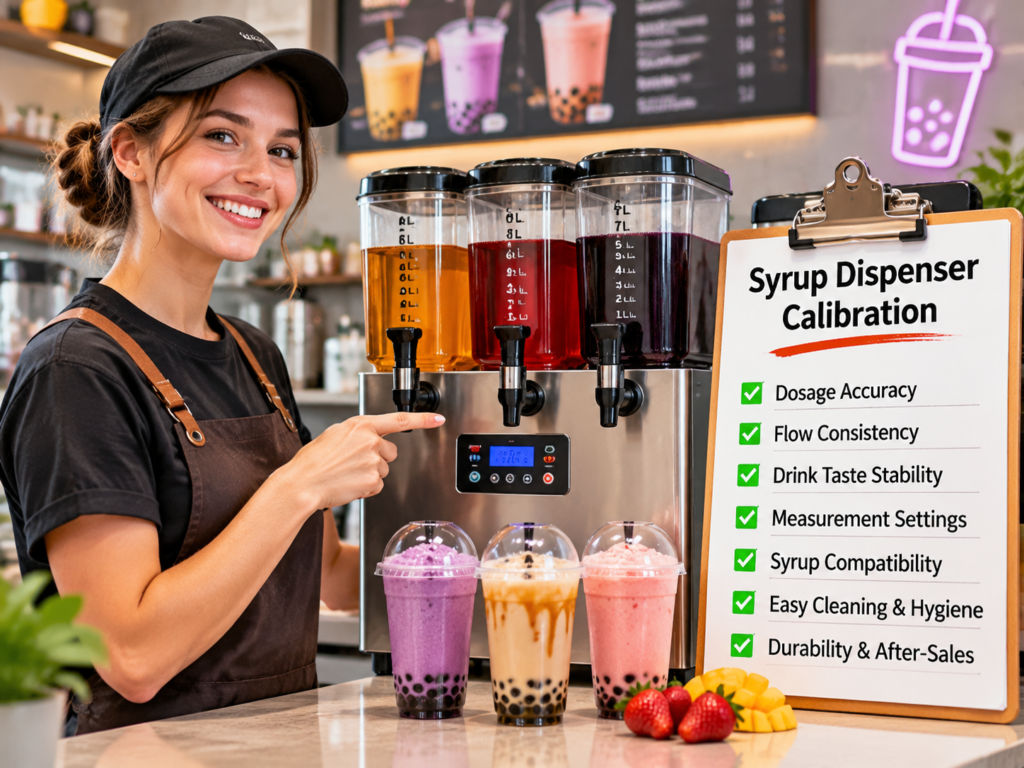
Syrup dispenser calibration helps a bubble tea shop turn a sweetness button into a measured recipe. Start by confirming the dose unit, use the intended syrup under normal approved operating conditions, measure repeated portions, and adjust only through the procedure supplied for the exact machine. Verify the result again before staff use the setting in service.
A digital display does not prove that the amount arriving in the cup matches the recipe. This guide explains seven practical checks for café owners, bubble tea operators and equipment distributors evaluating an automatic syrup dispenser. It also provides a sample test record and a purchasing checklist, so your team can discuss performance using evidence rather than a single demonstration.
What does syrup dispenser calibration actually check?
In everyday shop language, calibration often includes checking and adjusting output. More precisely, a verification test compares delivered portions with a known recipe target; adjustment changes the machine settings. Keep these steps separate in your records. A successful adjustment still needs a new verification test.
Accuracy and repeatability answer different questions. Accuracy concerns closeness to the intended amount. Repeatability concerns how closely successive portions agree under the same conditions. A commercial fructose dispenser can deliver similar portions that are all above the recipe target. It can also average close to the target while individual portions vary too much for service. Review both the average and the spread.
1. Confirm grams, millilitres and the meaning of the display
Before syrup dispenser calibration, identify whether your machine uses grams, millilitres, time-based settings or another programmed scale. Check the manual rather than assuming a displayed number is a measured weight. Some controls represent a stored setting rather than directly sensing every portion.
Grams measure mass; millilitres measure volume. Do not assume 20 mL of syrup weighs 20 g. If the recipe is defined by mass, weigh the delivered portion. If it is defined by volume, follow the documented volume-measurement method. Converting between the two requires density information applicable to that ingredient and temperature.
For multi-store operations, write the unit beside every target. A worksheet that says only “30” can lead two teams to validate different quantities. Also confirm whether the manufacturer’s stated tolerance is an absolute amount, a percentage, or a range that changes with dose size.
2. Use the actual syrup under approved working conditions
Identify the syrup supplier, product name and batch used for the test. Ingredient viscosity can affect dispensing, and a replacement sweetener may behave differently even when the label describes a similar flavour. Do not assume thick honey, sauces, pulp or syrups containing particles are compatible with a liquid sugar dispenser.
For context, the Narvon fructose dispenser manual identifies viscosity as a factor and advises recalibration after changing fructose supplier or type. That instruction applies to its specified machine; use the manual for your own unit to determine its procedure and limits.
Record syrup temperature and tank level. Test within the permitted operating range and maintain the required minimum fill level. Do not add water to change flow unless the approved recipe and equipment instructions explicitly permit it. A water-only test may help with a documented setup check, but it does not establish performance with the shop’s actual syrup.
3. Prepare the dispenser, cup and measuring equipment
Place the machine on the surface specified in its installation instructions. Complete approved cleaning, assembly and priming before testing. Air left in the dispensing path, an incorrectly fitted outlet or residue at the nozzle can make a test unrepresentative. Follow the manual to resolve these conditions rather than compensating with a recipe setting.
Use a suitable scale for mass-based recipes. Its capacity must accommodate the receiving vessel and syrup, while its resolution and verified performance must be adequate for the tolerance you intend to assess. A display that changes only in large increments cannot demonstrate a much smaller dosing tolerance. Check the scale using its recommended verification method.
Tare the clean receiving cup before each portion and collect syrup directly into it. Keep the collection position and end-of-dose observation consistent. Decide how to handle after-drips in line with the equipment instructions and actual serving practice. Do not scrape extra syrup from the nozzle into one test cup and omit it from the next.
4. Test repeated portions at real menu sizes
Choose representative small and large recipe doses. As a practical internal screening plan, you can record five consecutive portions at each setting; this is an example test plan, not a certification standard or a substitute for the supplier’s acceptance method. Use more extensive sampling where the application or agreed purchasing specification requires it.
Write down every reading. Do not select only the best portion or combine several doses into one cup and overlook individual variation. Record the mean, minimum and maximum. The range is the maximum minus the minimum; it provides a simple view of variation within that test.
| Check | Example result | What to review |
|---|---|---|
| Recipe target | 30.0 g | Confirm the target is defined by mass |
| Five portions | 31.0, 31.2, 30.9, 31.1, 31.3 g | Keep all individual readings |
| Mean delivered amount | 31.1 g | Average is 1.1 g above target |
| Observed range | 0.4 g | Compare with an agreed acceptance limit |
| Decision | No automatic pass or fail | Review both target deviation and variation |
In this example, similar readings do not establish correct portion size. Define acceptance criteria before the test, considering recipe sensitivity, measuring uncertainty and the exact dispenser’s documented performance. There is no universal tolerance that every bubble tea syrup dispenser must achieve.
5. Follow the model-specific adjustment procedure, then retest
If the average output differs from the target, first confirm the unit, ingredient, fill condition and measuring setup. Make an adjustment only if the manual provides an operator procedure. Control codes and button sequences vary between machines, so a video for a different model is not a reliable instruction.
For example, the Omcan fructose dispenser manual includes its own output adjustment and verification steps. This illustrates why syrup dispenser calibration needs the correct manual; those settings should not be copied to another brand or configuration.
After an authorised adjustment, repeat the measured test at the relevant menu doses. Check that correcting a larger portion has not made the smaller one unsuitable. If portions vary widely, or leakage and interrupted flow persist, stop using the affected setting and seek the supplier’s troubleshooting guidance. Repeatedly changing a control value can hide an unresolved mechanical or ingredient problem.
6. Translate sweetness levels into measured drink recipes
“Half sugar” is a menu instruction, not a universal quantity. Define a full-sweetness syrup amount for each cup size and drink recipe, then document how the other sweetness choices relate to it. Do not assume customers ordering the same percentage across different drinks should receive an identical syrup dose.
A recipe can also contain sweetness from premixes, toppings or other ingredients. A syrup dispenser controls only the ingredient passing through it. It does not measure the total sugar in the finished drink. Check the complete beverage for taste and consistency after validating the measured syrup portion.
For staff training, identify the recipe version, approved ingredient and matching machine setting on a simple reference card. Keep the workflow consistent with your commercial bubble tea equipment workflow, including cup preparation, tea, toppings and final sealing.
7. Keep a verification log and define recheck triggers
A useful syrup dispenser calibration record includes the date, operator, machine identification, syrup details, operating conditions, target unit, individual readings, acceptance criteria, adjustment made and final verification result. Retain the original readings so a later problem can be compared with the approved baseline.
Define checks around meaningful changes: a new syrup formulation or supplier, relevant temperature changes, cleaning or servicing of the dispensing path, prolonged storage, or an observed change in output. Follow any more specific intervals required by the manual. A brief opening check may be appropriate for your operation, but it does not replace full verification when conditions change.
Handovers should identify who can change settings and who approves a recipe for service. Consistent records help distributors support customers remotely and help shop managers distinguish a training issue from a machine fault.
What should buyers ask before ordering a syrup dispenser?
- Which sweeteners, viscosity range and ingredient temperatures are approved?
- What do the display values and preset buttons represent?
- What dose range and performance are documented, and under which test conditions?
- Can the supplier demonstrate repeated small and large portions with a representative syrup?
- What are the working fill limits, nozzle clearance and cleaning requirements?
- Is an English manual available, with operator adjustment instructions and spare parts information?
- Which voltage, frequency and plug configuration will be supplied for the destination?
YLT Motion’s 8L digital fructose syrup dispenser is a relevant starting point for beverage equipment enquiries. Confirm usable capacity, approved ingredients, dose units and verified performance for the quoted version. The listed tank capacity does not establish dispensing speed, accuracy or a heating function.
For a complete station, review the automatic cup sealing machine alongside the dispenser, using your actual cups and film to assess compatibility. Evaluate the complete service sequence rather than selecting every machine by its headline specification.
Syrup dispenser calibration: frequently asked questions
Can I check a fructose dispenser using only water?
Water does not establish syrup dosing performance. Use the intended approved sweetener for final recipe verification, following the machine’s setup and adjustment instructions.
Does a digital syrup dispenser automatically weigh every dose?
Do not assume this from the display. Ask whether the system measures output directly or controls a programmed dispensing operation, and verify delivered portions independently.
How often should a bubble tea shop recalibrate?
Follow the model’s manual and your documented verification plan. Recheck when ingredients or operating conditions change, after relevant maintenance, or when output no longer matches the approved recipe.
Is an 8L tank enough for my shop?
Estimate demand from measured syrup use per drink, expected orders and refill access. Confirm the usable working capacity and minimum fill requirement; nominal capacity alone cannot determine service duration.
Plan a repeatable beverage station with YLT Motion
Send your syrup type, typical dose sizes, peak-hour drink volume, destination country and order quantity when you request a beverage equipment quotation. Ask for the exact technical sheet, operating manual and a representative dispensing test. YLT Motion supplies commercial beverage and food preparation equipment for distributors, cafés, restaurants and hospitality businesses worldwide.