Türkçe — ürün bilgileri ve satın alma rehberleri
ไทย — ข้อมูลสินค้าและคู่มือจัดซื้อ
Deutsch — Produktinformationen und Einkaufsratgeber
Русский — описание и руководство по выбору
Français — informations et guide d’achat
Português (Brasil) — detalhes e guia de compra
Español — detalles y guía de compra
العربية — تفاصيل المنتج أو الدليل
Bahasa Indonesia — Lihat produk atau panduan ini
Tiếng Việt — Xem nội dung bằng tiếng Việt
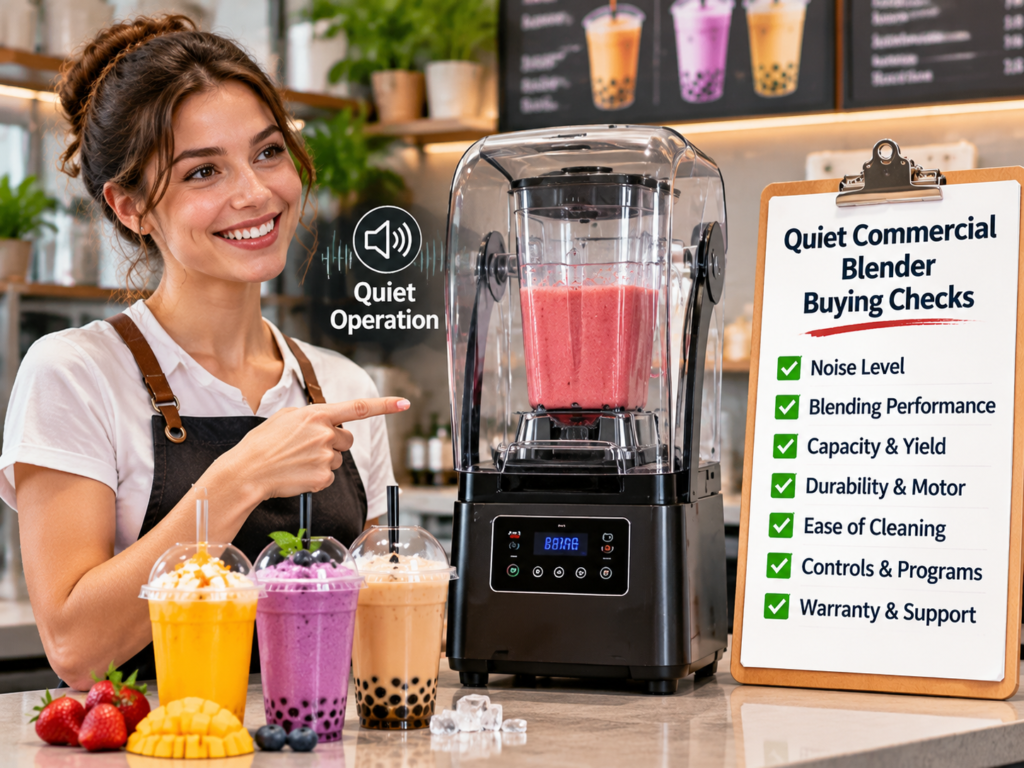
A quiet commercial blender should produce the required drink texture while keeping operating noise manageable at the service counter. Compare machines using the same recipe, load and listening position, then check enclosure access, ventilation and the complete preparation cycle. A sound enclosure can help reduce noise, but the label “soundproof” does not mean silent operation.
This guide is for café owners, juice bar operators, bubble tea shops and beverage equipment distributors. It focuses on evaluating a blender at an open counter, where staff need to take orders, prepare drinks and work around customers. The goal is a practical purchasing decision based on your menu and workspace, rather than a demonstration with conditions you cannot reproduce.
What makes a quiet commercial blender suitable for a café?
A suitable machine combines acceptable drink quality, workable noise levels and convenient daily operation. Noise control is a system issue: the enclosure, motor base, vibration management, recipe and installation all matter. Buying a transparent cover alone does not establish how a particular blender will perform at your counter.
As a manufacturer example, Vitamix describes several noise-reduction features in its covered commercial machine, including air management and vibration damping. That supports evaluating the complete design. It does not establish a noise rating or equivalent performance for another supplier’s equipment.
1. Define where the blender will operate
Start with a simple counter layout. Mark the blender position, order-taking point, nearest customer seating, ingredient storage and washing area. A quiet commercial blender beside a cashier faces a different requirement from a machine in a separate preparation room. Identify the conversations and activities that must remain practical during a blend cycle.
Ask staff to describe the actual issue: difficulty hearing an order, repeated interruptions, vibration through the counter, or a machine operating for long periods. These observations help you specify a meaningful trial. A small café may value a comfortable customer-facing station more than a large nominal jar capacity that the menu rarely uses.
Consider other equipment operating nearby. Ice handling, refrigeration, cup sealing and general shop activity can affect what people hear. Assess the proposed blender during representative service conditions, while also observing it in a quieter period so that background noise does not conceal its contribution.
2. Inspect the blender sound enclosure as a working component
Check that the cover belongs to the exact motor base and jar configuration being quoted. It must open and close correctly with the approved jar and lid in place. Look at the available opening space, handle access, visibility, hinges and any replaceable seals or cushions specified by the supplier.
A commercial blender with sound enclosure should be assessed as supplied. Do not assume a generic aftermarket box will fit safely or preserve the intended cooling path. Ask whether the enclosure is included in the price and whether replacement covers, hinges and approved mounting parts are available.
Distinguish the enclosure from the jar lid. The cover is not a substitute for securing the food container according to its instructions. Also ask whether the unit has an interlock and how it functions; do not infer an automatic stop feature from the presence of a cover. Operate the machine only in the configuration permitted by its manual.
3. Test the quiet commercial blender with your actual recipes
Choose representative drinks before requesting a demonstration. Include a common daily recipe and a demanding approved recipe, such as a frozen-fruit smoothie or ice-based beverage. Record ingredient quantities, ingredient condition, batch size, jar, program or speed setting and blending time.
A short demonstration using mostly water cannot establish performance with frozen fruit and ice. Likewise, a reduced speed that sounds pleasant may not deliver the required texture within your service time. Compare drink results alongside the sound: check for unprocessed pieces, inconsistent texture and the need to run another cycle.
For an initial purchasing comparison, use the same position, room, recipe and recording method for each candidate. Listen from the operator position and a realistic customer position. If you request decibel results, ask for the measurement distance, recipe, speed or program, background conditions, instrument and reported metric. Numbers produced under different methods are not a reliable like-for-like comparison.
Phone recordings can help document a demonstration, but automatic microphone processing and playback volume can alter the impression. Treat them as supporting context rather than proof of a specified sound level. If a formal acoustic assessment is required for the project, arrange an appropriate measurement process separately.
| Test item | Keep consistent | Record for each candidate |
|---|---|---|
| Recipe and load | Ingredient amounts and condition | Jar, batch size and approved settings |
| Drink quality | Target texture and serving size | Result, reblending and usable yield |
| Sound comparison | Room, position and measurement method | Listening observations and documented readings |
| Service cycle | Start and finish points | Preparation, blending, pouring and cleaning time |
| Installation | Proposed counter location | Open-cover clearance and required airflow space |
Do not assign a universal “quiet enough” threshold from this worksheet. Define acceptance criteria for your own service needs before comparing a quiet commercial blender with another model.
4. Check open-cover clearance and motor ventilation
Measure the space with the enclosure fully open, not just the blender’s closed height. Check overhead shelves, wall proximity, access to the power switch and the path used to lift out a filled jar. A machine that fits under a shelf may still be awkward to operate.
The Blendtec commercial owner’s manual illustrates why installation details matter: it identifies ventilation paths and clearance for sound-enclosure movement on its specified models. Obtain the corresponding requirements for the machine you are buying rather than copying another model’s dimensions.
Do not reduce noise by blocking vents, wrapping the motor base, placing it in an improvised sealed cabinet or adding unapproved materials underneath it. Ask the supplier about approved installation and vibration-control options. For an in-counter installation, confirm that the exact version supports it and obtain the installation drawing before modifying the counter.
A quiet commercial blender still needs its specified cooling conditions. Review these requirements against nearby heat-producing appliances and the intended service schedule.
5. Time the full drink cycle during a peak-hour trial
The fastest blend program does not necessarily create the fastest station. Measure loading, closing the lid and cover, blending, removing the jar, pouring and the cleaning steps required before the next recipe. Watch whether staff have to move cups or ingredients every time the enclosure opens.
For a blender for bubble tea shops, also consider topping preparation and final cup sealing. For a smoothie blender for cafes, examine access to frozen ingredients and the order-taking area. Use the same workflow assumptions when comparing equipment packages.
Illustrative planning example: if a full preparation cycle takes 90 seconds, the uninterrupted mathematical rate is 40 cycles per hour. That is not a verified production rating. Staffing, refilling, cleaning, recipe changes and customer interruptions reduce practical capacity, and the manufacturer’s duty limits still apply. Test a representative sequence instead of turning a short demonstration into a continuous-output claim.
Discuss spare jars or an additional station if the observed workflow requires them. More equipment also means more counter space, cleaning and electrical planning. Our smoothie bar workflow guide provides related preparation-planning questions.
6. Review cleaning access, wear parts and daily inspection
Ask how to remove and clean the enclosure using the exact model’s instructions. Confirm approved cleaning products and whether any parts are dishwasher safe. Do not transfer a dishwasher claim from the jar to the cover, or from one manufacturer’s product to another.
Inspect accessible hinges, cushions, mounting points and the jar’s seating during the documented maintenance routine. A loose component or damaged part needs attention; changing the speed or holding the cover down by hand is not a repair. Stop and follow service guidance if the machine develops unusual vibration, rattling or a sudden change in sound.
Include the motor base, jar assembly and enclosure in your spare-parts discussion. Ask for part identification, replacement availability and service instructions. For a quiet commercial blender used throughout the day, a cover that cannot be replaced can become a practical purchasing concern even if the motor remains functional.
7. Confirm the exact quiet commercial blender configuration
Request a written technical sheet that matches the sample tested. Record the motor base, jar and lid, enclosure, controls, electrical version and included accessories. Appearance alone cannot confirm that two offered versions have the same capacity, programs or operating characteristics.
- Confirm approved recipes, usable working volume and permitted duty cycle.
- Ask for voltage, frequency, rated input and plug details for the destination.
- Request closed dimensions, open-cover dimensions and ventilation clearances.
- Define any noise-performance claim together with its test conditions.
- Confirm the cleaning manual, replacement parts, warranty and service process.
- For wholesale orders, agree packaging, lead time, branding and sample approval requirements.
YLT Motion’s commercial smoothie blender with sound enclosure is a starting point for discussing an open-counter beverage station. Buyers can also review the 1.8L commercial smoothie blender with 9-speed touch controls. Confirm the exact configuration and test results before selecting between them; this guide does not assign either product an unverified decibel rating.
Quiet commercial blender: frequently asked questions
Is a soundproof blender completely silent?
No. “Soundproof blender” is often a product-category description for equipment with a noise-reducing enclosure. Evaluate the complete machine with a realistic recipe instead of treating the wording as a guarantee of silence.
Can I add a sound enclosure to any blender?
Do not assume compatibility. Use an enclosure approved for the exact base, jar and installation, with the required access and cooling space.
Is a higher-powered blender always louder?
Rated power alone does not establish the sound at the counter. Compare the complete configuration under the same recipe and test conditions, while checking drink quality and preparation time.
What is the best quiet commercial blender for a small café?
The best fit is the model that meets your menu, workspace, sound expectations and service needs in a representative trial. There is no single jar size or advertised noise claim that answers this for every café.
Request equipment advice for your beverage counter
YLT Motion supplies commercial beverage and food preparation equipment for distributors, restaurants, cafés and hospitality businesses worldwide. When you request a quiet commercial blender quotation, include your destination country, recipes, typical batch size, expected peak-hour demand and available counter dimensions. Ask for the matching specification sheet, operating manual and a representative recipe demonstration so your purchasing decision is based on the version you will receive.