Türkçe — ürün bilgileri ve satın alma rehberleri
ไทย — ข้อมูลสินค้าและคู่มือจัดซื้อ
Deutsch — Produktinformationen und Einkaufsratgeber
Русский — описание и руководство по выбору
Français — informations et guide d’achat
Português (Brasil) — detalhes e guia de compra
Español — detalles y guía de compra
العربية — تفاصيل المنتج أو الدليل
Bahasa Indonesia — Lihat produk atau panduan ini
Tiếng Việt — Xem nội dung bằng tiếng Việt
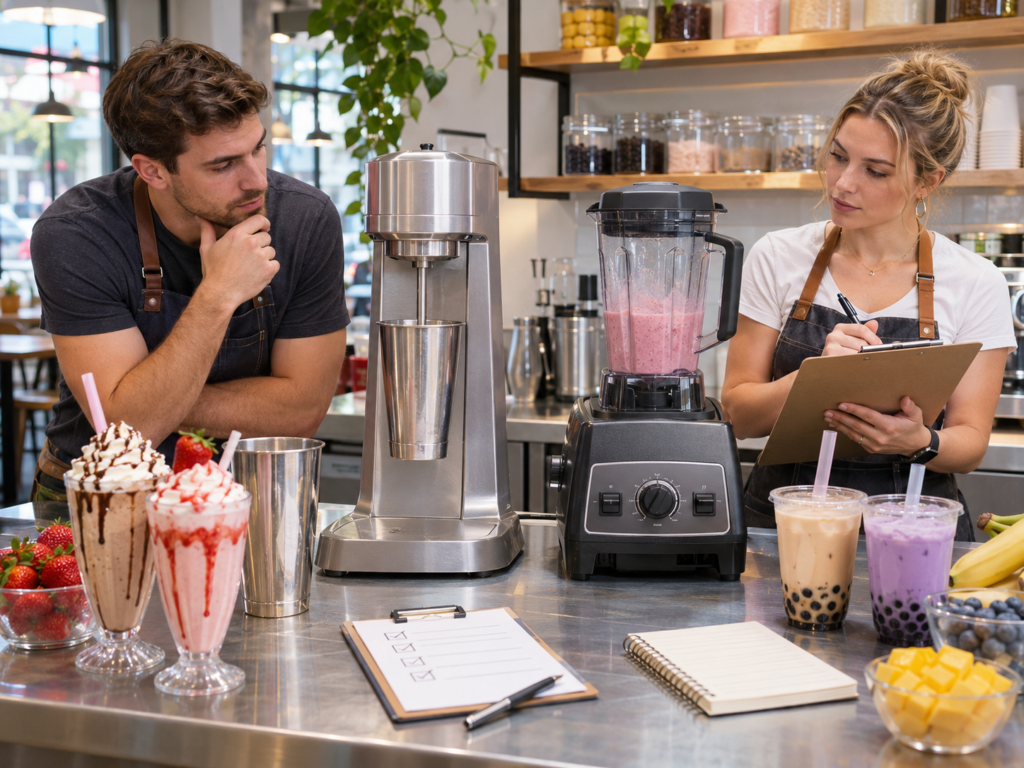
Milkshake machine vs blender: choose a spindle drink mixer for recipes that need approved cup-based mixing; choose a commercial blender when the menu needs blade-based processing of approved fruit, ice or other ingredients. A blender may also make milkshakes. The right purchase depends on the recipe, finished texture and complete service workflow—not the drink name alone.
For cafes, bubble tea shops and restaurant buyers, the useful question is what each machine must do with your actual ingredients. This guide compares the equipment categories, provides seven buying checks and explains how to request a comparable quotation. Capabilities, accessories and electrical versions must be confirmed for the exact equipment offered.
Milkshake machine vs blender: a quick comparison
Here, milkshake machine means a spindle drink mixer that operates in a separate mixing cup. A commercial blender uses a blade assembly in its container. These categories overlap in some drink applications, while their working methods and approved ingredients differ.
| Buying question | Spindle milkshake mixer | Commercial beverage blender |
|---|---|---|
| How is the drink processed? | An agitator on a spindle mixes ingredients in a separate cup. | A blade assembly processes ingredients inside a blender container. |
| Which menu should be tested? | Your approved milk, ice cream, syrup and other mixing recipes. | Your approved smoothies, frozen drinks, fruit blends and shake recipes. |
| What about hard ice or frozen pieces? | Obtain explicit approval for the ingredients and loading; do not assume ice-crushing capability. | Confirm the model’s approved ingredients, loading and operating procedure. |
| What determines capacity? | Usable cup fill, mixing time, cup handling and cleaning. | Approved batch size, processing time, pouring, cleaning and required rest periods. |
| What should be checked on multi-position equipment? | Motor count, independent control and permitted simultaneous operation. | Container availability, base compatibility and how staff share preparation tasks. |
Seven checks for choosing a milkshake machine or commercial blender
1. Write the recipe before selecting the equipment
List the ingredients by weight, including milk, ice cream, fruit, ice and powders where relevant. Record their starting temperature and preparation. A drink made from milk and softened ice cream creates a different processing task from a smoothie containing ice cubes and frozen fruit.
Separate mixing from cutting or crushing. A milkshake mixer is not automatically an ice crusher, and a blender is not automatically approved for every dense or frozen recipe. Ask the supplier to test the offered configuration with your ingredients within its operating limits. For bubble tea equipment planning, identify which drinks actually require a blender instead of buying one for every tea-based recipe.
2. Define the texture you intend to sell
When comparing a milkshake machine vs blender, specify the desired result: consistency, remaining pieces, pourability and the texture at the point of service. The machine category alone does not guarantee a particular amount of aeration, a thicker shake or a smoother drink.
Compare the same recipe at the same serving size. Record the selected setting and the time between processing and serving. An attractive demonstration drink prepared with different ingredients is useful inspiration, but it does not establish the result your menu will deliver.
3. Check both minimum and maximum working portions
A cup or jar’s nominal volume is not its permitted working fill. Ask for the approved loading range and test the smallest order you sell as well as the largest intended batch. A larger container can be a poor match for small portions if the ingredients do not engage the mixing system effectively.
For a single-head milkshake machine, confirm the actual cup and its usable fill. For a commercial smoothie blender, confirm the container, blade assembly and recipe limits as a matched set. Do not turn a litre figure into a universal number of servings without defining the recipe and serving size.
4. Measure the entire service cycle
Include weighing, loading, mixing, removing or pouring the drink, cleaning and returning the station to a ready state. Respect the manufacturer’s working and rest limits. A short motor-running demonstration does not prove sustainable hourly output.
A double-head milkshake machine should be assessed by its actual motor arrangement, independent controls and simultaneous-use limits. Two mixing positions do not automatically double the output of a station staffed by one person. Shared ingredients, cup preparation and washing can remain the bottleneck.
5. Compare sound and counter access under the same conditions
Place the equipment in the proposed workstation and check access for loading, cup removal and cleaning. Measure lid or sound-cover opening clearance as well as the machine footprint. Shipping-carton dimensions are not installation dimensions.
A sound enclosure may be relevant for a customer-facing blender station, but assess it with the same recipe and listening position. Request the conditions behind any sound figure. Confirm the function of the enclosure; sound protection by itself does not establish vacuum blending. Check ventilation and the operator’s movements before finalizing the layout.
6. Plan cleaning, changeovers and replacement parts
On a spindle mixer, identify the cup, agitator, spindle and splash areas that contact the recipe. On a blender, identify the jar, lid, seals and blade assembly. Ask which parts the operator may remove and how each is cleaned. Follow the equipment instructions and the business’s food-safety and allergen procedures.
A rinse cycle is not a universal cleaning or sanitizing method. Separate cups also do not by themselves control contact through shared ingredients, tools or staff. For maintenance planning, request part references and compatibility details. Similar appearance or capacity does not prove that a replacement cup, jar or coupling fits.
7. Compare the complete quotation, not only the machine price
A useful milkshake machine vs blender quotation names the equipment configuration, included cups or jars, mixing tools, controls and electrical version. Ask for voltage, frequency and plug or connection details for the installation site. A different plug does not convert voltage, and separate voltage options do not establish automatic dual-voltage operation.
List the order quantity and destination city and country. Separate equipment, freight, installation and essential spare or consumable items where applicable. Confirm customization, lead time, warranty and support in the current offer. Availability of documents or accessories should be checked for the exact version being purchased.
Milkshake machine vs blender: a worked workflow example
Consider a cafe selling both ice-cream milkshakes and frozen-fruit smoothies. First test each recipe with the equipment intended for that task. Then time a representative order sequence from ingredient preparation to the next ready-to-use station.
Illustrative calculation, not a product performance claim: if loading, processing, pouring and cleaning occupy one workstation for 90 seconds per accepted drink, the arithmetic upper bound is 3,600 ÷ 90 = 40 drinks per hour before breaks, rest periods, interruptions or shared-resource delays. Timing only 30 seconds of motor operation would suggest 120 cycles per hour and omit most of the work.
If the same employee portions ingredients and washes cups for both machines, buying an additional mixing position may not remove that delay. Compare an extra compatible cup or jar, a revised preparation sequence and an additional machine as separate options. Preserve recipe quality and required operating limits in every trial.
Milkshake machine vs blender: frequently asked questions
Can a commercial blender make milkshakes?
It can be suitable when the model and container are approved for the recipe. Test the actual ice cream, liquid ratio, portion and desired texture. A blender’s ability to make one shake does not establish identical results across every recipe or working fill.
Can a spindle milkshake machine crush ice?
Do not assume it can. Request explicit confirmation for hard ice, frozen ingredients and the proposed loading. If ice reduction is an essential step, evaluate equipment specifically approved for that task. Approval for mixing an ice-cream recipe is not the same as approval for crushing ice cubes.
Does a bubble tea shop need both types?
Only if the menu and measured workflow justify them. Some drinks may need neither blade processing nor a spindle mixer. A shop selling both frozen-fruit blends and separately mixed dairy drinks should test the required processes before selecting the equipment mix.
Is a double-head machine always faster?
No. Confirm the actual motors and controls, and measure staff, preparation and cleaning as well as mixing. In a milkshake machine vs blender comparison, useful output means accepted drinks delivered through the complete station under stated conditions.
Related YLT Motion equipment and practical guides
- Single-head stainless steel milkshake machine — review the offered cup, controls, electrical version and operating limits.
- Double-cup milkshake machine — confirm motor arrangement and independent operation before planning parallel service.
- Commercial sound-enclosure smoothie blender — evaluate the proposed configuration with your actual recipe and counter layout.
- Milkshake machine cleaning and maintenance guide — prepare the cleaning questions for your supplier.
- Commercial blender buying guide — compare recipe fit, containers and purchasing requirements.
Request a recipe-based equipment quotation
To turn a milkshake machine vs blender comparison into a purchase decision, send YLT Motion your recipe, smallest and largest portions, peak order mix, destination, electrical requirements and order quantity. Add any cup, jar, branding or documentation requirements. Request a confirmed configuration and sample-test criteria rather than assuming every option shown is included.
YLT Motion supplies commercial beverage and food preparation equipment for distributors, restaurants, cafes and hospitality businesses worldwide. Send your equipment inquiry or contact YLT Motion on WhatsApp to discuss the proposed application and quotation scope.
Equipment-category references
Manufacturer material provides examples of the two categories: Hamilton Beach Commercial drink mixers and the Vitamix commercial beverage blender. Confirm YLT Motion specifications, approved ingredients and accessories against the exact configuration offered.