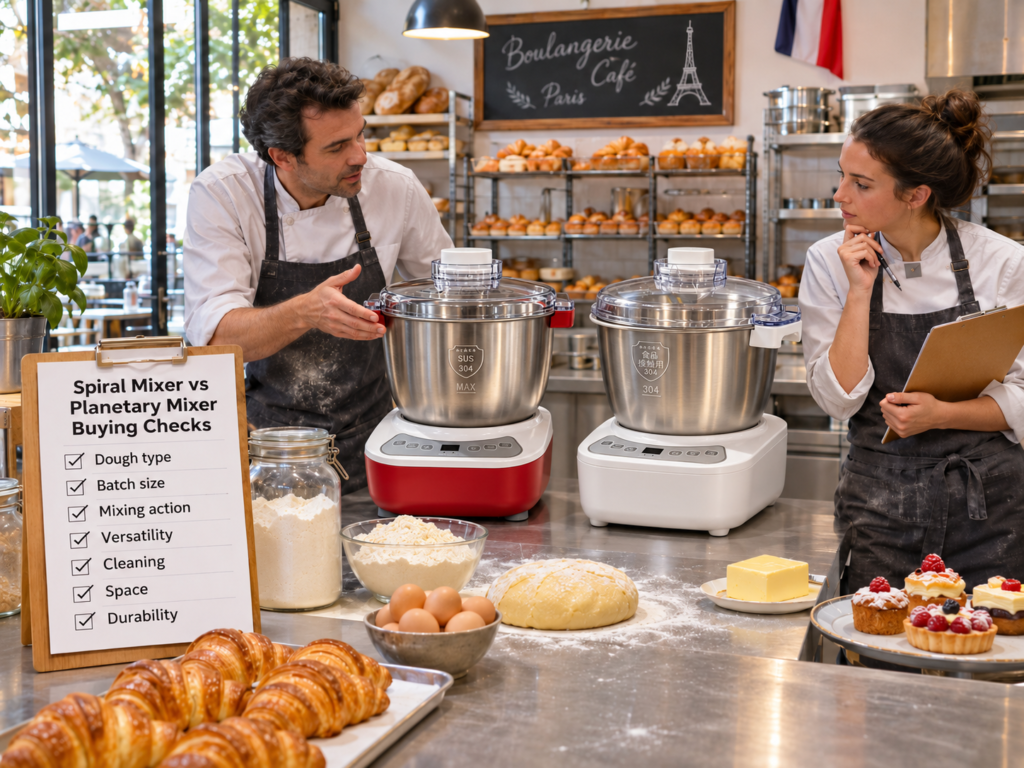
Spiral mixer vs planetary mixer is a practical buying decision for cafes adding baked goods, small bakeries and pizza kitchens. Start with the recipes you actually make, the smallest and largest batches, and the full preparation schedule. Bowl litres and motor wattage alone cannot tell you whether a mixer will handle your dough or fit your daily service.
Quick answer: Consider a spiral mixer when dough preparation is the main job. Consider a planetary mixer when you need compatible tools for a mixed menu such as dough, batter and whipped mixtures. Confirm the exact model’s approved recipes, load limits and attachments before buying. A compact dough maker is a separate option to evaluate for modest, scheduled batches.
Spiral Mixer vs Planetary Mixer: The Main Differences
In a conventional planetary mixer, the attachment rotates while travelling around the bowl. A spiral mixer combines a spiral kneading tool with a rotating bowl. The mechanism helps identify the machine type, but the tool’s shape alone is not enough: a spiral-shaped hook fitted to a planetary mixer does not make the machine a spiral mixer.
Hobart’s manufacturer comparison of planetary and spiral mixers describes planetary equipment as versatile across different preparations and spiral equipment as a dough-focused option. Treat those general differences as a starting point; use the manual and capacity chart for the specific machine you are considering.
| Buying question | Spiral mixer | Planetary mixer | Compact dough maker |
|---|---|---|---|
| Main job to investigate | Repeated bread or pizza dough preparation | A varied menu using approved mixing tools | Suitable small dough batches and available programs |
| Tools to confirm | Kneading assembly and any model-specific accessories | Approved hook, beater and whisk options | Supplied kneading tool and bowl configuration |
| Capacity evidence | Recipe-specific flour and total dough limits | Separate limits for each recipe and attachment | Approved minimum and maximum loads, not bowl litres alone |
| Trial priority | Your normal dough and smallest batch | Your hardest recipe plus a light mixture | Your exact recipe and planned daily schedule |
| Do not assume | Every model supports the same load or attachments | A dough hook approves every dough recipe | Fermentation programs establish commercial duty |
1. Match the Mixer to Your Actual Menu
List the preparations you make each week and mark which one creates the greatest workload. A pizza dough mixer used mainly for kneading needs a different evaluation from a bakery mixer shared between cake batter, icing and occasional bread dough. Include seasonal menu changes, but do not buy around an untested future menu alone.
For a mixed cafe menu, ask whether the proposed planetary mixer includes the necessary attachments and whether each is approved for the intended recipe. For a bread-focused operation, ask the spiral mixer supplier for evidence using the flour and dough style you plan to produce. Neither category name guarantees a successful result with your formula.
If you are beginning with modest batches, review our 5L and 7L electric dough mixer with fermentation. This is a compact dough-making option to assess separately, rather than a substitute assumed to have the capabilities of either commercial mixer category. Confirm intended business use and approved duty before ordering.
2. Compare Dough Weight, Not Just Bowl Litres
Keep three figures separate: nominal bowl volume, flour weight and total ingredient weight. A 7L bowl does not establish a 7kg dough rating. Likewise, the same bowl volume on two different machines does not establish equal working capacity.
Required portioned dough = number of portions × dough weight per portion. For example, 16 pizza bases at 250g require 4kg of portioned dough before any measured handling loss. This is a planning example, not an approved load for a product on this site.
Record the smallest routine batch too. If you prepare a large batch at the weekend and a small batch midweek, request evidence that the machine can mix both within its approved range. Our dough mixer capacity guide for 5L and 7L bowls explains the difference between vessel size and recipe-specific loading. Use that guide for sizing; use this comparison to decide which mixing format to investigate.
3. Specify Hydration and the Complete Recipe
Dough hydration is water weight divided by flour weight, multiplied by 100. A simple formula containing 1kg flour and 600g water has 60% hydration. With 20g salt and 10g yeast, its total ingredient weight is 1.63kg. Keep the hydration calculation separate from the total batch calculation.
Hobart’s guidance on mixer bowl size and absorption ratio explains why recommended capacity depends on the preparation and its moisture content. Do not transfer a manufacturer’s capacity figure to a different brand, recipe or operating condition.
Give the supplier the full recipe, including flour type, water temperature, fats, eggs and other additions. Ask for the approved speed, loading sequence and batch range for that formula. A claim such as “suitable for bread” is less useful than written limits tied to the bread dough you intend to make.
4. Test a Complete Batch Before Choosing a Bread Dough Mixer
For a useful spiral mixer vs planetary mixer trial, keep the recipe and the desired outcome consistent. Record what the operator does as well as the machine’s running time. A short demonstration with an unidentified load does not establish suitability for your everyday production.
- Identify the exact model, bowl, tool and electrical version used.
- Weigh the ingredients and record their starting conditions.
- Use the manufacturer’s approved settings and loading procedure.
- Record mixing time, finished dough temperature and any manual intervention.
- Assess the dough through your normal resting, shaping and baking process.
- Include unloading, tool changes and cleaning in the trial record.
For a planetary mixer, test the other important menu item as well. A machine selected around pizza dough still needs checking with your smallest batter or whipped mixture if those preparations are part of the purchasing brief. Request a separate result for each attachment rather than generalizing from one test.
5. Build a Schedule Around the Full Preparation Cycle
A small bakery dough mixer must fit the production window, including weighing, mixing, unloading, cleaning and any prescribed rest periods. Avoid using kneading time alone as an hourly output claim. Fermentation, shaping and oven availability can also determine whether the planned menu is achievable.
Here is a scheduling illustration: if an approved batch produces 2kg of usable dough and the measured complete preparation cycle takes 20 minutes, three cycles represent 6kg over an hour on paper. This assumes all required pauses are already included. It is not a continuous-duty claim, and it does not establish baked output or a capacity rating for a particular machine.
For cafe staff who also prepare drinks, check whether weighing and unloading collide with the busiest service period. Consider preparing approved batches before service rather than expecting a larger bowl to solve a staffing constraint. Record the actual bottleneck before selecting more equipment.
6. Check Counter Space, Electrical Supply and Cleaning Access
A countertop dough mixer needs enough room for operation as well as storage. Ask for the footprint with the head, lid, bowl lift or guard in its working position. Confirm weight, support requirements, access for removing the bowl and the clearance specified by the manufacturer.
Before ordering, confirm rated voltage, frequency, power and the connection requirements for the exact version. Do not assume that a plug change converts a 110V machine into a 220V machine. Obtain destination-specific product documents and ask a qualified installer to assess the proposed connection where required.
Check how food-contact parts are cleaned and which components are removable according to the instructions. Include replacement tools, seals and bowls in your service planning. Follow the supplied safety instructions; stop and isolate the machine as directed before removing tools or carrying out cleaning tasks.
7. Request a Quote That Identifies the Exact Configuration
A commercial dough mixer quote should describe what is supplied and the conditions under which the machine is recommended. Ask for accessories, electrical configuration, approved recipe limits, spare parts, preparation time, delivery scope and warranty terms in writing. Compare equivalent offers rather than the headline machine price alone.
| Send with your enquiry | Ask the supplier to confirm |
|---|---|
| Menu, flour type and full recipe | Suitable mixing format and recipe restrictions |
| Smallest and largest total batch weights | Approved load range for the selected model |
| Batches per day and preparation window | Operating time and required rest periods |
| Other preparations such as batter or cream | Compatible tools and separate application limits |
| Country, city and electrical requirements | Exact voltage, frequency, plug and relevant documents |
| Quantity and required accessories | Itemized price, delivery scope and support terms |
Copy this enquiry: “We are comparing a spiral mixer vs planetary mixer for [menu]. Our recipe is [ingredients and weights], with [hydration] and total batches from [minimum] to [maximum]. We plan [batches per day] within [preparation window]. Please recommend a suitable configuration and confirm load limits, attachments, duty cycle, electrical version, delivery and support for [destination].”
Spiral Mixer vs Planetary Mixer: Frequently Asked Questions
Which is better for a small bakery: a spiral mixer or a planetary mixer?
Choose according to the menu and validated batch requirements. Investigate a spiral mixer for dough-focused production and a planetary mixer for varied preparations requiring different tools. Obtain a recipe trial and model-specific limits before deciding.
Can a planetary mixer make pizza dough?
A suitable planetary mixer can knead dough with an approved hook, within the manufacturer’s recipe, speed and batch limits. The presence of a dough hook does not establish that every pizza dough or batch size is permitted.
Does a spiral dough hook make a stand mixer a spiral mixer?
No. The mixing mechanism determines the category. A spiral-shaped hook used in a planetary machine is an attachment, not evidence that the bowl and tool operate as a spiral mixer system.
How much dough can a 5L or 7L mixer make?
There is no universal conversion from bowl litres to dough kilograms. Ask for approved minimum and maximum loads for your recipe and the exact version. Include the total ingredient weight and operating schedule.
Can a compact dough maker replace a commercial bakery mixer?
Only when its intended use, approved recipe loads and operating schedule meet the application. Do not infer commercial duty or repeated production capacity from bowl size, wattage or a fermentation function.
What information helps a supplier recommend a pizza dough mixer?
Send the complete recipe, flour type, hydration, total batch range, batches per day, preparation window and destination electrical requirements. Include any batter, cream or other tasks the same machine must perform.
Compare Mixer Options with YLT Motion
Start with the 5L and 7L dough maker specifications if you are evaluating compact, scheduled dough preparation. For a broader project, browse our beverage and food preparation equipment center. Availability and suitability of a requested mixer format are confirmed with the quotation; this guide does not imply that every format is stocked.
Send your recipe and request a mixer quotation, or ask for recipe-based mixer advice on WhatsApp.