العربية — تفاصيل المنتج أو الدليل
Bahasa Indonesia — Lihat produk atau panduan ini
Tiếng Việt — Xem nội dung bằng tiếng Việt
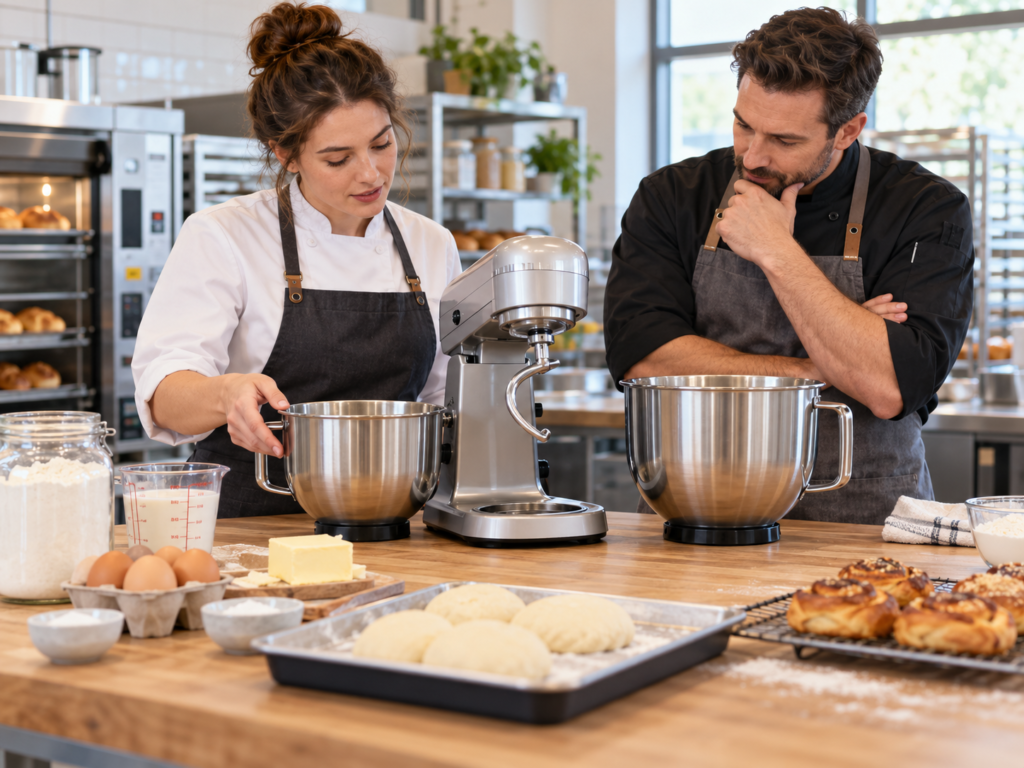
Dough mixer capacity is more than the number of liters printed beside a mixing bowl. A 5L or 7L electric dough mixer must handle your recipe, batch weight and preparation schedule within its approved operating limits. Choosing only by bowl volume can lead to unsuitable loads, extra batches or a machine that does not match the job.
Quick answer: calculate the total dough weight you need, identify the recipe and hydration, then compare that requirement with the manufacturer’s approved minimum and maximum batch loads. Confirm mixing speed, duty cycle and the full preparation schedule before deciding between 5L and 7L options.
What Does Dough Mixer Capacity Actually Mean?
Product listings may use capacity to describe several different measurements. Bowl volume tells you the size of the vessel. Flour capacity describes the permitted flour weight under specified conditions. Total dough capacity includes water and every other ingredient. These figures are related, but they are not interchangeable.
| Measurement | What it describes | What buyers should ask |
|---|---|---|
| Bowl volume, such as 5L or 7L | Nominal vessel volume | What working fill limits apply? |
| Flour weight | Flour loaded for a specified formula | Which recipe, hydration and speed were tested? |
| Total dough weight | Combined weight of all ingredients | What minimum and maximum loads are approved? |
| Production output | Usable dough prepared over time | Does the cycle include unloading, cleaning and required pauses? |
A 5L bowl is not a promise that the machine can knead 5kg of flour. Likewise, a 7L bowl does not automatically provide 40% more usable dough output than a 5L version. Bowl geometry, mixing mechanism, drive system and recipe restrictions also matter.
1. Calculate the Dough Weight Your Menu Requires
Begin with the items you intend to prepare, rather than a target bowl size. Multiply the number of portions by the dough weight per portion, then account for the process losses you actually measure in your kitchen.
Required dough weight = number of portions × dough weight per portion.
For example, 12 portions at 120g require 1,440g of portioned dough before allowing for handling losses. This is a hypothetical planning example, not a rated batch for any 5L or 7L dough kneading machine. Your menu, portion size and working method determine the actual requirement.
Separate your usual batch from occasional larger orders. A machine that handles a rare large batch may still be inconvenient for small everyday preparations. Record both requirements when discussing dough mixer capacity with a supplier.
2. Convert the Recipe into Total Ingredient Weight
Weigh flour, water, salt, yeast and all other ingredients. Do not compare a recipe’s flour weight with a machine specification for total dough weight. That mistake can make an apparently suitable mixer too small for the intended batch.
Consider an illustrative formula containing 1,000g flour, 650g water, 20g salt and 10g yeast. The total is 1,680g. This demonstrates ingredient accounting only; it is not a recommended recipe or a confirmed load for a particular appliance.
For enriched bread, include eggs, butter, milk and sugar in the total. If using a preferment or starter, account for it consistently and avoid counting its ingredients twice. Keep a complete formula so the supplier can assess the same batch you intend to mix.
3. Include Hydration When Assessing Dough Mixer Capacity
For a simple flour-and-water calculation, hydration is water weight divided by flour weight, multiplied by 100. In the example above, 650g of water divided by 1,000g of flour gives 65% hydration. King Arthur Baking’s baker’s percentage reference explains how ingredient weights can be expressed relative to flour.
Recipe moisture is relevant to equipment selection. Hobart’s mixer capacity guidance explains that dough capacity depends on the application and moisture content, rather than bowl size alone. Use the capacity information for the exact machine you are buying; another manufacturer’s chart cannot establish its rating.
A softer bread dough and a stiff pasta dough of equal weight can behave differently in the bowl. Flour type, inclusions and the mixing process also affect the task. Do not assume that a successful pizza dough test proves suitability for every bread, noodle or dumpling recipe.
Tell the supplier which formula you plan to use and ask for the applicable loading limit. Never increase hydration just to force a machine to accept a batch if that changes the product you need to make.
4. Compare the Minimum Batch as Well as the Maximum
The largest approved load is only part of dough mixer capacity. Ask whether your smallest batch engages the mixing component properly and produces an acceptable result. This is especially useful for cafes preparing modest quantities or businesses testing new recipes.
When comparing a 5L dough mixer with a 7L dough mixer, request a demonstration at your routine load. Do not assume that the larger bowl will mix a very small recipe equally well, or that one bowl can be swapped onto the other base.
Check whether the bowl and kneading component are matched to each version. Ask about spare bowl availability, removal and refitting. Choose a configuration that supports the actual range of batches you make, rather than paying only for unused nominal space.
5. Measure the Full Cycle and Fermentation Occupancy
Practical output depends on how soon the appliance can begin the next batch. Include loading, mixing, unloading, cleaning and any required rest periods. The motor’s displayed mixing time is not the whole production cycle.
Theoretical mixed dough output per hour = validated batch weight × 60 ÷ complete cycle minutes. Treat this as planning arithmetic, then check staff availability and downstream preparation.
For a hypothetical machine yielding 1.5kg in a complete 30-minute cycle, the calculation is 3kg per hour. That figure does not describe the output of the YLT Motion 5L or 7L product, and it does not include fermentation unless fermentation occupies the machine within that cycle.
A dough maker with fermentation can simplify a small batch workflow, but the bowl may remain occupied while the dough rises. Confirm whether dough stays in the same vessel, whether another batch can be prepared, and which steps are supported by the manual. A combined program is not automatically the highest-throughput arrangement.
6. Match the Mixer Type and Duty Cycle to the Work
A compact electric dough maker, a planetary stand mixer and an industrial spiral mixer are different equipment categories. Similar bowl volumes do not establish equal load handling, attachment functions or commercial suitability. Compare the exact mechanism and intended use.
Ask for the approved kneading speed, maximum operating duration and any rest requirements. Input wattage alone does not prove usable dough mixer capacity, torque or continuous production capability. A machine marketed for household use needs separate confirmation before being selected for repeated business use.
For bread and pizza production, request a test with your actual formula. For cake batter or whipped cream, check that the correct attachments and functions are provided. A covered dough kneader should not be assumed to perform every task of a general-purpose stand mixer.
7. Check Installation, Cleaning and Support
Verify voltage, frequency and plug for the destination. A listing showing 110V and 220V may describe separate versions. Review the site’s commercial equipment voltage guide alongside the nameplate and installation requirements for the ordered unit.
Measure working space for loading, bowl removal and cleaning. Check which parts may be washed separately and how the motor base must be protected. Stainless steel construction does not, by itself, establish dishwasher compatibility for an assembled component.
Request the manual, spare parts list and warranty terms in writing. Confirm support for the exact bowl version and configuration. An acceptable dough mixer capacity trial is most useful when the unit can also be maintained reliably throughout its intended working schedule.
5L vs 7L Dough Mixer: A Practical Decision Guide
| Your requirement | What to compare |
|---|---|
| Small routine batches | Minimum approved load and mixing engagement in each bowl |
| Occasional larger preparations | Recipe-specific maximum load, additional batches and full cycle time |
| Stiff pasta or dumpling dough | Explicit recipe compatibility and loading restrictions |
| Mixing followed by in-bowl rising | Fermentation settings and the time the vessel remains occupied |
| Repeated cafe or bakery production | Commercial suitability, duty cycle and service support |
There is no universal kilogram conversion that makes every 5L or 7L mixer comparable. Ask for a written, recipe-specific specification and choose the model that performs the required job within its limits.
Dough Mixer Capacity Acceptance Checklist
- Record the full recipe and total ingredient weight.
- Identify hydration, flour type and relevant inclusions.
- Confirm minimum and maximum approved loads for that formula.
- Demonstrate the smallest routine batch and the proposed largest batch.
- Record mixing settings and assess the dough against your recipe requirements.
- Time loading, mixing, unloading, cleaning and required pauses.
- Check whether fermentation occupies the mixing bowl.
- Verify electrical configuration, intended use and duty cycle.
- Obtain cleaning instructions, replacement part details and support terms.
Discuss Your Preparation Plan with YLT Motion
YLT Motion supplies commercial beverage and food preparation equipment for distributors, restaurants, cafes and hospitality businesses worldwide. Explore the food processing equipment range and evaluate each appliance against its specific task and approved operating conditions.
To discuss dough mixer capacity, contact YLT Motion with your recipe, usual and maximum batch weights, destination, electrical supply and daily schedule. These details support a more useful equipment discussion than bowl liters alone.
Frequently Asked Questions
Does a 5L dough mixer hold 5kg of flour?
No. Liters describe vessel volume. Approved flour weight and total dough weight depend on the specific machine, recipe and operating conditions.
Is a 7L dough mixer always better than a 5L version?
No. Compare routine batch size, minimum mixing load, recipe limits and cycle time. Additional bowl volume is useful only when the machine suits the work.
Can I calculate dough mixer capacity from motor watts?
Wattage alone cannot establish the permitted dough load. Obtain the manufacturer’s capacity specification and validate the relevant recipe.
Can a dough maker with fermentation bake bread?
A fermentation function supports a rising stage. It does not establish a baking function. Confirm the appliance’s actual capabilities and plan shaping and cooking separately.
Should bread and pasta dough use the same maximum load?
Do not assume so. Their formulations and mixing requirements may differ. Ask for recipe-specific suitability and limits for the ordered machine.