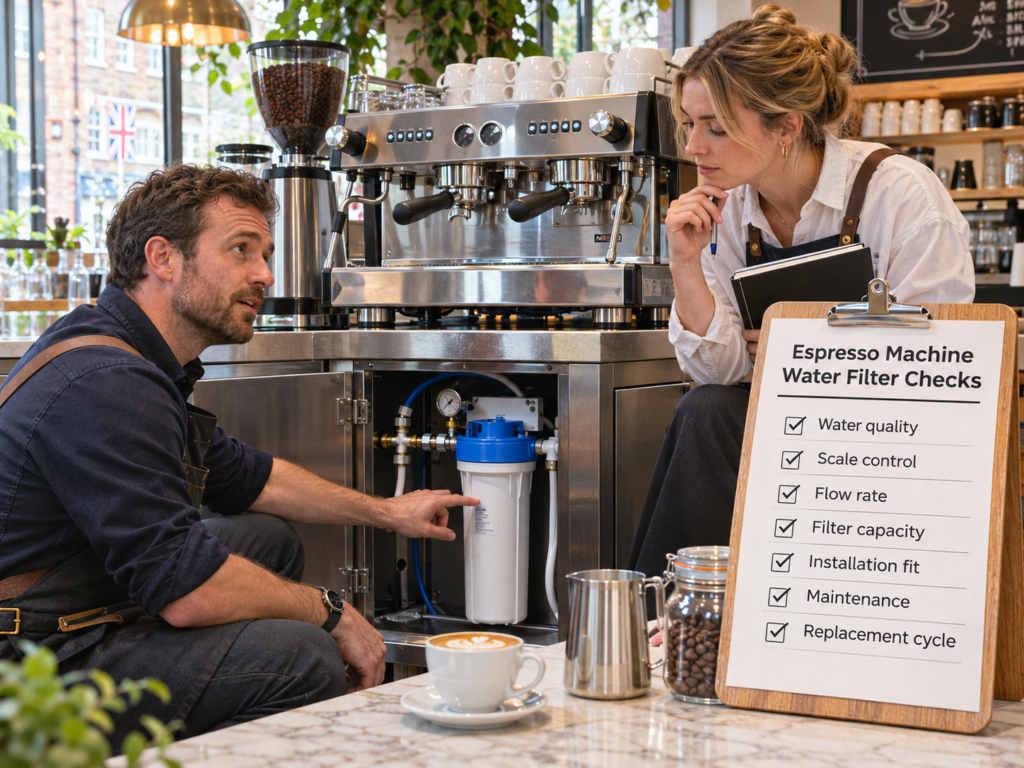
Choosing an espresso machine water filter starts with your local water test and the requirements of the exact coffee machine you intend to buy. A filter that fits the inlet is only one part of the decision. Water chemistry, flow, cartridge capacity and maintenance access all belong on the purchasing checklist.
This guide helps cafe owners, restaurant operators and equipment distributors compare commercial coffee machine water filtration options before installation. It focuses on the questions to ask suppliers and the records to keep, rather than prescribing one water recipe for every boiler.
Quick answer: which water filter does an espresso machine need?
The right espresso machine water filter is a treatment system selected against a water analysis and the machine manufacturer’s written water specifications. Confirm the required treatment, the available flow under load, the cartridge replacement conditions and the installation arrangement. Do not choose from a TDS reading, a generic filter label or the coffee machine’s pump pressure alone.
1. Test the supply before choosing an espresso machine water filter
Ask a water treatment specialist which tests are needed for your installation. A useful procurement brief identifies the source, sampling point, test date and measurement units. Keep the incoming-water results separate from any results taken after an existing treatment system.
For espresso machine water quality, hardness, alkalinity, pH, chloride and disinfectant measurements may need attention alongside total dissolved solids. These are different measurements. A single TDS value does not show the complete mineral composition or confirm that a supply meets every requirement in a machine manual.
| Information | Buyer action |
|---|---|
| Source and sampling point | Identify mains, bottled or another approved supply and any existing treatment. |
| Hardness and alkalinity | Record both values and their units; ask the specialist to compare them with the machine specification. |
| TDS, pH and relevant chemical results | Provide the complete report instead of sending only a meter photograph. |
| Cold-water pressure and available flow | Have the installer measure the supply under the conditions requested by the equipment supplier. |
| Test date and site address | Use results relevant to the actual installation, especially when opening another branch. |
For a multi-site cafe business, create one water record per location. Buying identical coffee machines does not mean every branch needs the same treatment configuration.
2. Request the exact machine’s water requirements
Obtain the installation manual before committing to an espresso machine water filter. Ask the seller for acceptable water parameters, inlet pressure and flow requirements, connection details, drainage requirements and any treatment-related warranty conditions.
Manufacturer documentation illustrates why this matters: the La Marzocco Linea PB installation guide lists water chemistry and installation requirements for that equipment. Those figures are not automatically specifications for a different brand or machine.
When comparing a dual boiler espresso machine with a smaller reservoir model, include the water arrangement in your comparison sheet. Ask whether the quoted version supports a tank, a direct connection or both. Confirm which accessories are included and which installation components must be sourced separately.
3. Compare filtration, scale treatment and reverse osmosis
The term coffee machine water filter covers products with different purposes. Ask for the treatment function and the expected outlet-water results in writing. A cartridge described as improving taste should not automatically be treated as a solution for every scale or corrosion concern.
| Option being considered | Question to resolve |
|---|---|
| Particle and carbon filtration | Which particles or taste-related substances does this product address, and what remains untreated? |
| Hardness or alkalinity treatment | How will the selected cartridge change the measured water, and does its outlet meet this machine’s requirements? |
| Reverse osmosis with appropriate post-treatment | What final mineral composition is delivered, and how is it verified after installation? |
| Existing building treatment | Is a separate coffee-equipment stage needed after the building system? |
For example, BWT’s bestaqua ROC Min documentation describes a system that combines reverse osmosis with remineralization. This demonstrates a treatment approach, not a universal recommendation or a claim that this accessory is supplied with YLT Motion equipment.
If you are researching reverse osmosis water for espresso machines, ask about the complete system and its final output. Do not assume untreated RO output or distilled water is suitable simply because it contains fewer dissolved substances.
4. Check flow, space and the direct water connection
An espresso machine water filter must work within the complete installation. Have the installer confirm the available flow and pressure after treatment, the specified inlet fittings, shut-off access and the route to the machine. Check these requirements against the exact ordered version.
The advertised 9-bar extraction pressure of a rotary pump espresso machine describes a brewing function; it is not an instruction to supply the inlet at 9 bar. Use the manufacturer’s separate inlet specification when discussing a plumbed-in espresso machine with your installer.
Draw the proposed counter layout before ordering. Mark the machine, filter location, service access and any required drain. Leave the clearance specified for cartridge replacement. An inexpensive cartridge can become inconvenient if changing it requires moving a heavy machine every time.
If the equipment uses a reservoir, decide who prepares the approved water, refills the tank and maintains the treatment equipment. A reservoir changes the workflow but does not remove the need to check water suitability.
5. Compare cartridge capacity and the full running cost
Ask how the supplier calculated cartridge capacity for your measured supply and selected settings. Request the operating assumptions behind any quoted litre figure. Include water used during normal cleaning and flushing when discussing demand; drink volume alone is an incomplete purchasing brief.
A practical espresso machine water filter budget includes the initial system, installation, replacement cartridges, testing and service visits. Where applicable, also ask about power, consumables and wastewater from the proposed treatment system. Get these items quoted separately so competing offers can be compared.
Planning example: if an installer confirms a usable cartridge allowance of 3,000 litres for a particular site, and that site measures 20 litres of treated-water use per day, the volume-only estimate is 150 days. This is illustrative arithmetic, not a cartridge specification or a replacement recommendation. Follow any earlier time-based limit and the supplier’s actual service instructions.
6. Build water checks into the maintenance routine
Assign responsibility for checking the espresso machine water filter and keeping service records. Record the cartridge identification, installation date, meter reading where available, selected settings and the next action required by the treatment supplier.
La Marzocco’s water guidance emphasizes testing water suitability and replacing filter elements according to the relevant manufacturer’s recommendations. Its guidance also notes that water quality varies by location. Use your own equipment and treatment instructions to create the actual schedule.
For commercial espresso machine maintenance, keep filtration, routine cleaning and any approved descaling procedure as separate tasks in the operating plan. Do not improvise a descaling chemical, concentration or boiler procedure from a general online article. Ask the machine supplier which work belongs with trained service personnel.
Retest when advised by your specialist, and review the setup after a move, a supply change or an alteration to building treatment. Keep those results with the original installation record so the service team can compare like with like.
7. Send a complete coffee equipment enquiry
When asking YLT Motion about a coffee machine, send the destination country, expected drinks menu, estimated daily demand, busiest service period and preferred water connection. Include the water report and ask for the matching machine’s installation documents.
Use this copy-ready purchasing checklist:
- Exact machine and ordered electrical version, including voltage, frequency and plug or connection arrangement.
- Required water chemistry, inlet pressure, flow and fittings.
- Reservoir or direct-water configuration and any drainage requirements.
- Proposed treatment system and responsibility for selecting, installing and verifying it.
- Included accessories, separately purchased components and replacement consumables.
- Local service arrangements, documentation and applicable warranty conditions.
Compare the commercial dual boiler espresso machine with rotary pump and PID control when reviewing cafe equipment options. For home or office requirements, review the separate 20-bar semi-automatic espresso machine and confirm its intended duty and water instructions. These serve different purchasing needs; filter compatibility must be confirmed for the chosen machine.
Frequently asked questions
What is the best espresso machine water filter for a cafe?
The best choice is the system that delivers water within your specific machine’s requirements at the required flow, with a workable maintenance plan. Start with a site water analysis and request written confirmation from the equipment and treatment suppliers.
Is bottled water suitable for an espresso machine?
It may be suitable, but the label alone is not enough. Compare tested results with the machine’s water requirements and account for possible changes in the bottled-water supply.
Can I choose a filter using only a TDS meter?
No. A TDS reading cannot replace the other measurements requested by the manufacturer. Ask for a water test that covers the relevant parameters, including hardness and alkalinity where specified.
Can I use reverse osmosis water for espresso?
Confirm the final treated water rather than approving the term RO alone. Some coffee-water systems combine reverse osmosis with remineralization. The selected configuration must produce water suitable for the particular machine.
How often should a coffee machine filter cartridge be replaced?
Use the treatment manufacturer’s limits and service instructions for the actual supply, settings and consumption. Keep both installation dates and volume records where available; there is no single interval for every cafe.
Does a water filter mean the machine never needs servicing?
No. Water treatment is one part of equipment care. The machine still needs the cleaning, inspection and servicing required in its manual, and the treatment system needs its own maintenance.
Discuss your coffee machine installation with YLT Motion
Planning a cafe, restaurant coffee station or distributor order? Share your destination, menu, service demand, water report and electrical requirements. Ask for a suitable equipment quotation and the installation details needed by your local technician.
Ask YLT Motion on WhatsApp or email li1232809@gmail.com. Confirm the machine configuration and treatment responsibilities before placing an order.
Prepared by YLT Motion. Technical references reviewed November 24, 2026. External manufacturer guidance is provided for context; the manual and written requirements for your ordered equipment take precedence.