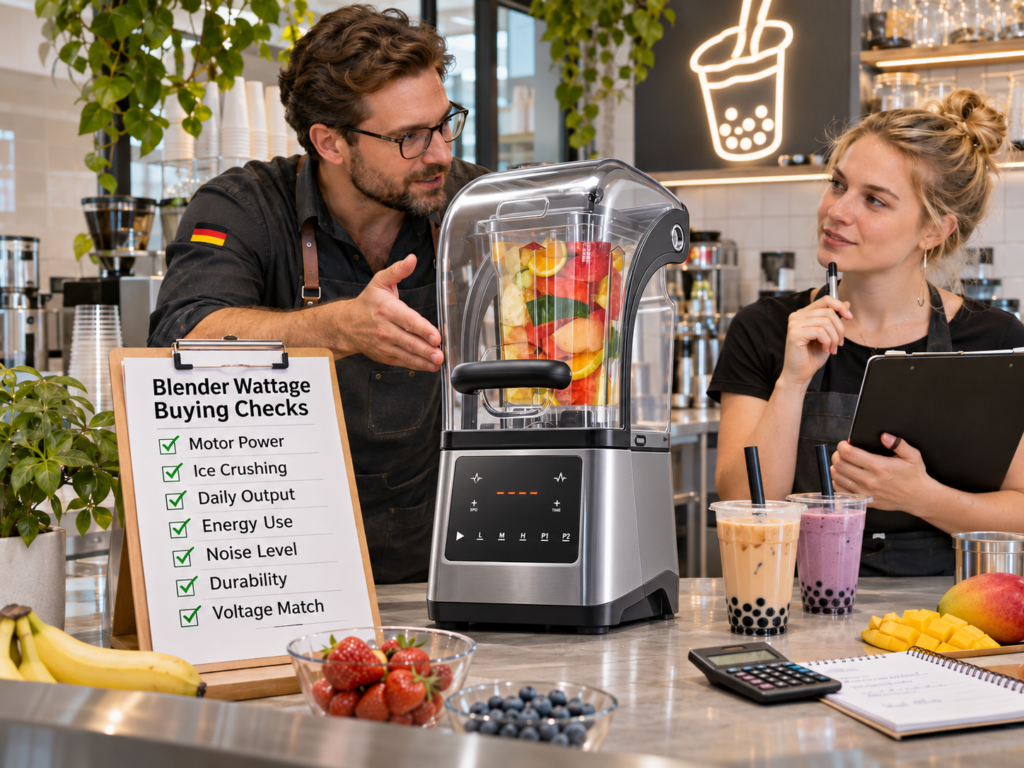
Commercial blender wattage is an electrical specification, not a complete measure of blending performance. Choose a machine by testing your permitted recipes, working portions and repeated service sequence, then confirm its electrical version, cooling requirements and support. A larger watt number alone does not establish smoother drinks, faster service or continuous operation.
This commercial blender wattage guide helps cafe owners, juice bars, bubble tea shops and equipment distributors compare quotations on the same basis. It explains which questions belong on a specification sheet and which require a practical trial. The examples are purchasing calculations, not measured performance or savings claims for a particular YLT Motion product.
1. Identify What the Commercial Blender Wattage Figure Describes
Ask whether the number is rated electrical input, an advertised maximum, or a separately described motor-output claim. Keep the original unit and definition in your comparison sheet. Do not treat watts, peak horsepower, running horsepower and unloaded speed as interchangeable specifications without an explanation of their measurement basis.
A commercial smoothie blender is a complete system. The motor, drive coupling, blade assembly, jar shape, controls and recipe interact during use. An electrical-input figure does not tell you how well that system will process a particular frozen drink. Ask for the rating label and a current technical sheet for the exact offered configuration.
| Listed figure | What to clarify | What it does not prove alone |
|---|---|---|
| Wattage | The stated rating, electrical version and measurement basis | Drink texture or repeatable output |
| Horsepower | Whether the claim is peak, operating or another defined value | A directly comparable electrical-input rating |
| RPM | The load and conditions used for the stated speed | Speed maintained with your recipe |
| Jar litres | Nominal volume and permitted working fill | Usable portions or servings per hour |
For commercial blender wattage comparisons, missing definitions are a reason to request clarification. They are not a reason to invent a conversion or choose whichever listing displays the largest number.
2. Test the Ingredients and Working Portions You Actually Sell
Write a recipe by weight before comparing a high power commercial blender with another option. Specify liquid, fruit, ice or frozen ingredients, starting condition and intended serving size. Use only ingredients and loading methods permitted for the proposed machine and container. A thin fruit drink and a dense frozen mixture are different processing tasks.
Test the smallest regular order as well as the largest approved batch. A large jar may not suit a small portion, and nominal capacity is not permission to fill it to the rim. Check whether ingredients circulate correctly, whether pieces remain and whether a second blend is needed. Record the finished texture at the point of service, not only while the mixture is moving.
When assessing commercial blender wattage for ice-based drinks, ask the supplier to demonstrate the actual ice size, quantity and liquid ratio within the machine’s limits. Do not infer approval for ice crushing, dry grinding or hot ingredients from the power figure alone. Keep each test recipe consistent so the comparison is meaningful.
3. Measure the Whole Service Cycle, Not Only Motor Running Time
A blender can finish its programmed cycle while the operator still needs to remove the jar, pour the drink, handle ingredients and clean for the next order. Compare the complete station with the same start and finish points. Include required pauses and record whether one person shares tasks with a cup sealer, topping station or cashier.
Illustrative workflow calculation: a station that completes one accepted serving every 90 seconds has an arithmetic rate of 3,600 ÷ 90 = 40 servings per hour before interruptions. Timing only a 30-second blending cycle would suggest 120 cycles per hour and omit other work. Neither calculation is a verified production rating for a specific blender.
Commercial blender wattage therefore belongs beside a service trial, not in place of one. Record repeatable accepted portions, any reblending and the time spent returning the workstation to readiness. If staff handling is the bottleneck, changing the motor rating alone may not resolve it.
4. Check Ventilation, Cooling and Documented Operating Limits
Request the permitted run time, rest periods, batch limits and operating conditions for the exact model. A short successful demonstration does not establish continuous-duty suitability. Ask how to respond to a thermal-protection event and when inspection or service is required; do not repeatedly restart the machine to force an overloaded recipe through.
For context, Blendtec’s commercial care guidance includes ventilation and correct installation among its maintenance checks. That supports checking the complete installation. Its specific clearances and electrical instructions apply to its equipment and should not be copied as universal requirements for another machine.
For a commercial blender with sound enclosure, verify opening clearance, access to the jar and the approved airflow path. Do not reduce noise by covering vents, wrapping the base or installing an improvised sealed box. A commercial blender wattage claim does not override the supplier’s ventilation or duty-cycle instructions.
5. Confirm Voltage, Frequency and the Supplied Electrical Build
Specify the destination country, supply voltage, frequency and required connection before ordering. Ask the supplier to confirm rated input, rated current where specified, plug or connection arrangement and installation instructions for the delivered version. The available circuit and other equipment at the station need assessment against the actual equipment requirements.
A listing offering 110–120V and 220–240V may describe separate builds. It does not by itself establish automatic universal-voltage operation. A plug adapter changes the connection shape, not the operating voltage. Have a qualified installer assess the proposed arrangement where required; a purchasing worksheet is not a circuit-design instruction.
Compare commercial blender wattage only after matching the electrical versions. Retain the agreed technical sheet and check the delivered rating label against the order. For multi-country distributors, keep each approved configuration, label and accessory set identifiable rather than treating visually similar machines as electrically identical.
6. Calculate Energy per Accepted Batch Using Actual Use
Watts describe power; kilowatt-hours describe energy used over time. Virginia Cooperative Extension’s energy-use guidance explains the relationship between wattage and operating time. For a blender comparison, use a representative measured average input or measured energy rather than assuming the advertised rating is its constant draw throughout a shift.
Energy calculation example: if a hypothetical trial averages 1.2kW while blending and accumulated blending time is 0.5 hours per day, that part of the schedule uses 0.6kWh per day. Over 26 operating days, it becomes 15.6kWh. Add other measured operating states separately and multiply by your applicable electricity tariff. These are invented inputs for arithmetic, not a YLT Motion consumption claim.
To compare blender energy consumption fairly, divide the measured trial energy by the number of accepted portions from that trial. Lower nameplate wattage does not automatically mean lower energy per drink if a different process needs longer or repeated cycles. Likewise, a higher listed figure does not establish that every drink will consume more energy.
Commercial blender wattage, energy cost and drink output answer different questions. Keep those columns separate, and use the same recipe and acceptance criteria when comparing equipment intended to perform the same task.
7. Compare the Complete Configuration and After-Sales Support
A useful quotation identifies the motor base, jar, blade assembly, controls, enclosure if included and electrical version. Confirm the permitted recipes, manual, cleaning method, spare-part references and warranty responsibilities. Similar jar sizes or couplings are not evidence of interchangeability.
When requesting commercial blender wattage information from YLT Motion, include the menu, recipe weights, working portions, busiest service interval and destination. Ask for a representative trial and written confirmation of the supplied configuration. Separate equipment, accessories, packaging and delivery terms so different offers can be compared fairly.
| Send to the supplier | Request confirmation |
|---|---|
| Recipes, ingredient condition and serving sizes | Permitted ingredients, working fill and proposed container |
| Peak order sequence and staffing | Complete trial results and operating/rest limits |
| Country, supply and available counter space | Electrical version, rating label, installation and ventilation |
| Quantity and required accessories | Included items, compatible spares and packaging |
| Delivery destination and service expectations | Lead time, warranty scope and support arrangements |
Related YLT Motion Blender Configurations
For configuration enquiries, review the 1800W commercial blender with a 1.8L jar and the listed 2000W commercial blender with a 1.6L jar and sound cover. The product names describe different listed configurations; they are not comparative test results. Confirm rated input, approved recipes, electrical build, working fill and operating limits before selecting either.
A smaller stated jar paired with a larger advertised power figure does not automatically deliver more portions. Use the seven checks above to compare the complete package against your own menu. YLT Motion can discuss commercial beverage and food preparation equipment for cafe, restaurant and distributor projects.
Commercial Blender Wattage: Frequently Asked Questions
How many watts does a commercial blender need?
There is no single wattage that proves suitability for every commercial recipe. Confirm the rating definition and test the exact machine, container, ingredients and workload. Select around accepted drink quality and the complete service process.
Is a 2000W blender always better than an 1800W blender?
No. Compare equivalent rating definitions and electrical builds, then evaluate recipe results, usable portions, cycle time, cooling, cleaning and support. The two numbers alone do not establish which configuration suits your business.
Does higher commercial blender wattage mean finer smoothies?
Not by itself. The approved recipe, container, blade system, controls and processing method influence the result. Test for remaining pieces and repeatability with the same ingredients rather than judging texture from a label.
Does wattage prove continuous-duty operation?
No. Request the documented run/rest limits and a repeated-workload demonstration. Follow the specific machine’s operating instructions even if the advertised power sounds appropriate for heavy use.
How should I compare electricity costs?
Compare measured energy for the same accepted output and recipe, then apply the relevant tariff. Keep active blending, other operating states and actual daily usage explicit. Nameplate power alone is not a monthly electricity bill.
What information helps YLT Motion recommend a configuration?
Send the menu, ingredient weights, portion sizes, peak orders, destination country, electrical requirements and purchase quantity. Include space, cleaning, accessory and documentation needs so the proposed equipment can be checked against the application.
Request a Commercial Blender Quotation
Send YLT Motion your commercial blender wattage questions together with the actual recipe and service requirements. Ask for the current specification, sample-test arrangements, included accessories, spare parts and lead time for the offered build. This gives your purchasing team a clearer basis for comparison.
Request a blender quotation on WhatsApp or email li1232809@gmail.com. Include quantity and destination so our team can discuss the configuration and delivery requirements.