العربية — تفاصيل المنتج أو الدليل
Bahasa Indonesia — Lihat produk atau panduan ini
Tiếng Việt — Xem nội dung bằng tiếng Việt
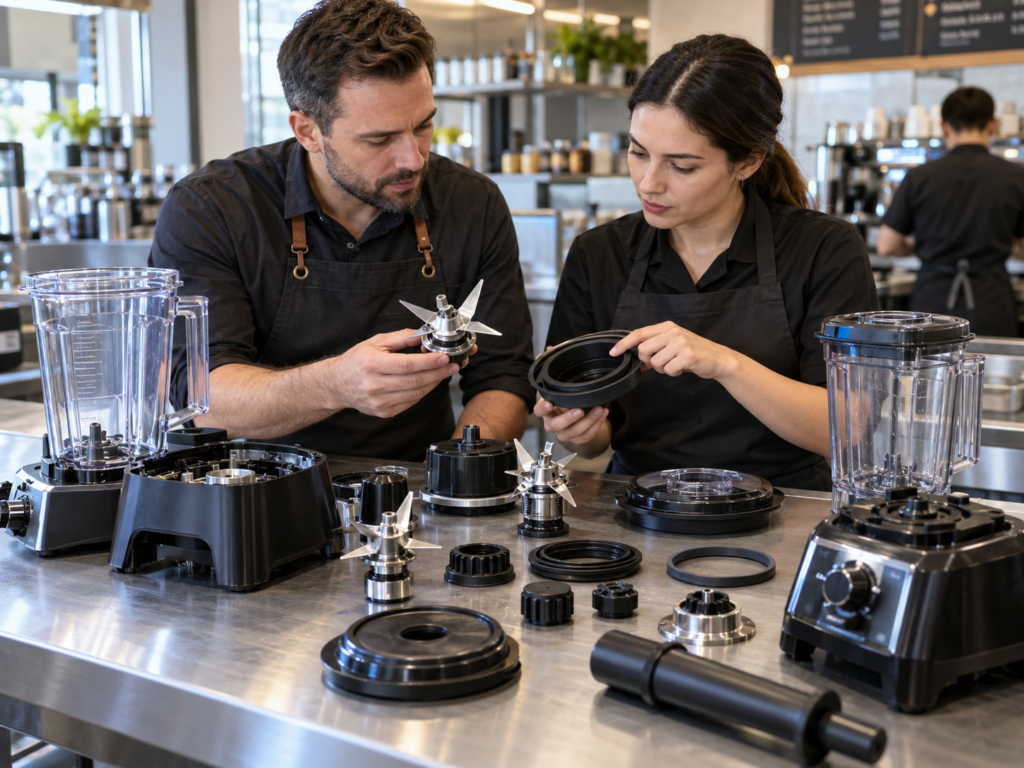
Commercial blender spare parts should be selected by the exact machine model, production revision and approved part number—not by appearance, jar capacity or advertised motor wattage alone. Before ordering a replacement blender jar, blade assembly, drive coupling or motor, ask the supplier to confirm compatibility in writing. A low-cost part that does not fit can create more downtime than the original fault.
This practical guide helps cafe owners, smoothie bars, restaurant operators and equipment distributors build a reliable spare-parts purchasing process. It covers seven buying checks, a component checklist, stock planning and a ready-to-use request for quotation.
Commercial blender spare parts: what should you identify first?
Start with the complete machine, then identify the failed component. A blender that does not blend correctly may have a recipe, loading or operating problem rather than a failed motor. Stop using equipment with damaged electrical components, a leaking container or an insecure blade assembly, and arrange an appropriate inspection before ordering.
| Component | Information to confirm | Purchasing consideration |
|---|---|---|
| Replacement blender jar and lid | Approved container part number, material, capacity, base interface and lid design | Equal capacity does not establish compatibility; check enclosure clearance too. |
| Blade assembly and seals | Container series, shaft, bearing, seal and retainer arrangement | Confirm whether a complete assembly or an individual service part is supplied. |
| Drive coupling or drive socket | Machine series, mating profile and approved kit number | Similar-looking couplings may belong to different product families. |
| Sound cover and hinges | Base mounting, container clearance and cover revision | Confirm access to the lid and any model-specific safety features. |
| Motor, switch or control board | Exact model, electrical ratings, mounting and production revision | Have a qualified service technician diagnose and install electrical components. |
7 essential checks before buying commercial blender spare parts
1. Record the exact machine identity
Photograph the rating plate and record the manufacturer, model, serial number and any production or date code. Keep a separate record for each machine in a fleet. Two units purchased under the same marketing name may have different internal components or later revisions.
Manufacturers publish model-specific service documents for a reason. For example, the official Waring BB300 exploded diagram and parts list identifies its electrical version and distinguishes wiring information by production date. Use the document for your own exact machine rather than borrowing a diagram from a similar blender.
2. Match the approved part number and revision
Ask for the original part number, replacement part number and any supersession notice. If a supplier proposes an alternative, request a written compatibility statement identifying the exact models and revisions it covers. Save that statement with the purchase order.
The word “universal” is not enough to approve commercial blender spare parts. Vitamix, for example, lists its commercial drive socket kit for specified blender families and explicitly excludes the XL series. This illustrates why a general component name cannot replace a model-level compatibility check.
3. Check the complete mechanical interface
For a replacement blender container, confirm the base footprint, seating arrangement, drive interface, overall height and lid fit. A 2-litre jar is a capacity description, not a mechanical specification. Check whether a sound enclosure closes normally and whether the approved container arrangement is maintained.
For a blade assembly, match the container series and complete fitting arrangement. Do not choose a blade simply because its diameter looks similar. The official Vitamix Advance blade assembly listing, for instance, names specific compatible Advance containers. That compatibility statement applies to the listed products, not to unrelated brands or jars.
4. Verify electrical specifications with the service technician
A commercial blender motor replacement requires more than matching watts. Provide the technician with the machine rating plate and the proposed motor or control-board specification. Voltage, frequency, mounting, connections, control compatibility and protective arrangements all need appropriate verification.
A plug adapter does not establish electrical compatibility. Do not substitute a motor or circuit board based only on a marketplace title. YLT Motion’s commercial blender motor replacement product can be used as an enquiry reference; suitability must be confirmed against your specific equipment before ordering.
5. Request food-contact and cleaning information
For jars, lids, seals and other food-contact components, request material information and relevant documentation for your destination market. Ask which cleaning chemicals, temperatures and procedures the manufacturer permits. Avoid assuming that a general “food grade” claim establishes every local requirement or every cleaning method.
Do not assume commercial blender spare parts are dishwasher-safe or suitable for hot liquids unless the relevant instructions say so. Inspect delivered components for cracks, damaged seals and manufacturing defects before putting them into service. Follow the machine and component instructions for cleaning and sanitizing.
6. Clarify what the replacement kit includes
Confirm whether the quotation covers a complete jar assembly, a jar without blades, an assembled blade unit or an individual component. Ask whether seals, retainers, fasteners or a model-specific service tool are included. Compare quotations on the same scope.
Separate operator-replaceable accessories from service work. Replacing an approved removable container is different from opening the base or dismantling a blade-bearing assembly. Use the manufacturer’s procedure and qualified service support where required; do not treat a parts list as an installation guide.
7. Confirm lead time, support and return conditions
Ask whether the item is physically in stock, the expected dispatch time, minimum order quantity, shipping terms and what happens if the supplied part is incompatible or damaged. Document warranty conditions and whether installation by an authorized service provider is required.
For distributors, agree on parts identification, technical support and ongoing availability before placing a bulk machine order. A spare-parts catalogue with clear model mappings is more useful than a long list of loosely described accessories.
How many commercial blender spare parts should you keep?
Plan spare stock around the installed machine base, actual replacement history, replenishment lead time and the consequence of downtime. A cafe using one blender has a different requirement from a distributor supporting several hundred machines. Do not adopt a fixed replacement interval without the manufacturer’s guidance and your own service records.
A simple starting point is: reorder point = expected usage during replenishment lead time + safety stock. For a hypothetical distributor using two approved lid assemblies per month with a one-month replenishment lead time and one lid as a buffer, the reorder point would be three lids. These numbers are an example, not an industry benchmark.
Track commercial blender spare parts by exact part number and compatible machine revision. Store components clean and protected according to the supplier’s instructions. Review slow-moving stock when a model is discontinued or a supplier changes a component. Keep stock for different revisions clearly separated.
When should you compare repair with a new machine?
Compare the confirmed repair cost, freight, technician charges and expected downtime with the cost and suitability of a replacement machine. Repeated failures may justify reviewing recipe loads, working conditions or equipment selection, rather than repeatedly buying the same component.
If replacement is appropriate, explore YLT Motion’s commercial blender range and commercial smoothie blender product. Ask about approved jars, service parts and support alongside the machine specification. These links are product references, not claims that their components fit other equipment.
Copy this supplier enquiry checklist
When requesting commercial blender spare parts, send one clear enquiry containing the following information:
- Machine brand, exact model, serial number and production code.
- Rating-plate photograph and destination country.
- Required component name and original part number, if known.
- Photographs of the complete machine and the relevant accessible component.
- Fault description, quantity required and preferred delivery date.
- Request for written compatibility confirmation and a complete kit-content list.
- Required material documents, installation instructions and warranty terms.
A useful closing question is: “Please confirm the exact compatible model and revision, electrical specification where applicable, included components, stock availability and return procedure before we approve the order.” Never dismantle energized equipment to obtain a photograph.
Commercial blender spare parts FAQ
Are commercial blender jars interchangeable?
Only use jars approved for the exact blender model. Matching capacity or a similar appearance does not establish drive fit, safe seating, lid fit or sound-cover clearance. Ask for the compatible part number before purchasing.
Can I replace only the blade instead of the whole jar?
That depends on the manufacturer’s design and service procedure. Some products have a specified replaceable blade assembly; others require a different service approach. Confirm the approved component, required tools and who should carry out the work.
Can a higher-wattage motor upgrade my blender?
Do not assume so. Motor compatibility involves the controls, mechanical mounting, electrical characteristics and protective design of the complete machine. Seek manufacturer approval and qualified technical assessment rather than treating wattage as an upgrade specification.
Which spare parts should a new cafe buy first?
Review the manufacturer’s recommendations and your service lead time. An approved complete spare jar and lid may help maintain beverage preparation during cleaning or an accessory failure, but the correct stock list depends on the equipment and operation. Confirm each item before ordering.
What information does a supplier need to identify a replacement part?
The most useful starting points are the exact model, serial or production code, original part number, rating plate and clear component photographs. A description such as “2L commercial blender” is normally too broad to establish a reliable match.
Request equipment and parts support from YLT Motion
YLT Motion supplies commercial beverage and food preparation equipment for distributors, cafes, restaurants and hospitality businesses. Contact YLT Motion with your equipment details to discuss product selection and parts enquiries. Availability and compatibility should be confirmed for the specific item before purchase.