العربية — تفاصيل المنتج أو الدليل
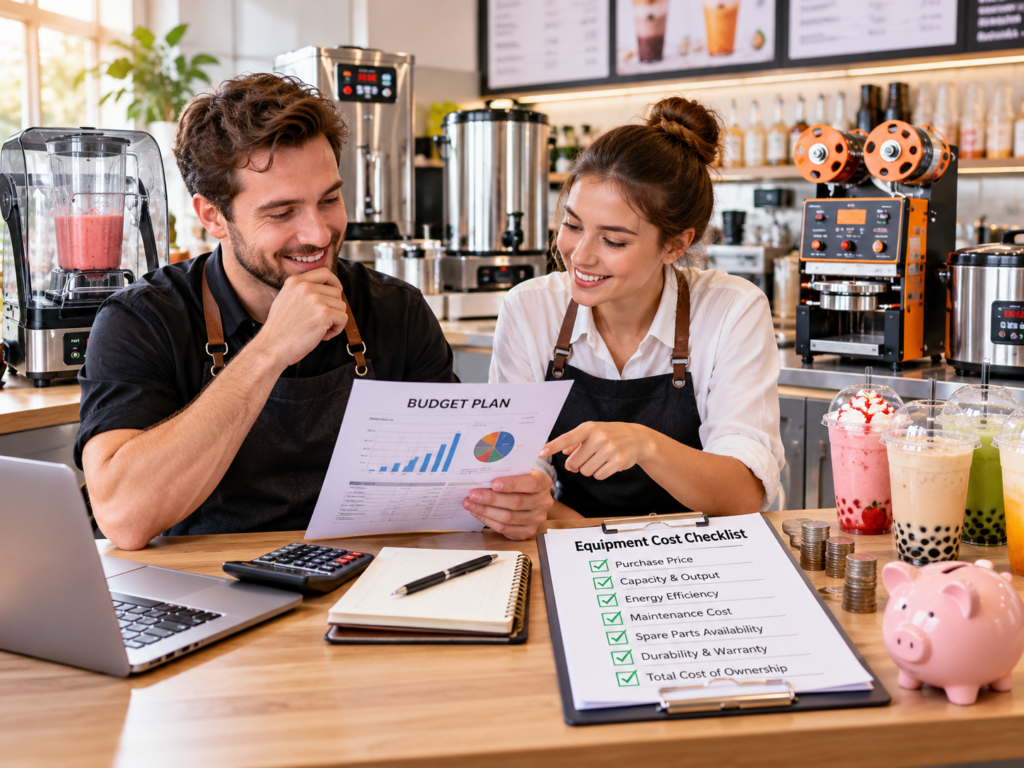
Commercial beverage equipment cost includes more than the purchase price of a blender, cup sealer or boba cooker. A useful buying comparison also includes installation, energy, consumables, cleaning labor, replacement parts and the consequences of interrupted service. Compare machines over the same period and at the same saleable output before deciding which quotation offers better value.
This guide is for cafe owners, bubble tea operators and equipment distributors preparing a purchasing budget. It provides a comparison method rather than a price list. All numerical examples are hypothetical; they are not YLT Motion quotations, utility tariffs, measured product performance or guaranteed savings.
1. Define the Scope of Commercial Beverage Equipment Cost
Start with the menu and the work each machine must perform. A bubble tea station may need hot water, tapioca cooking, syrup portioning and cup sealing. A smoothie menu adds blending requirements. A spindle milkshake mixer performs a different mixing task and should not be assumed suitable for crushing ice or processing frozen fruit.
List the main unit, essential accessories and optional spares separately. Ask whether the quotation includes a jar, blade assembly, compatible cup holder, power lead, measuring tools and protective shipping packaging. Two products with similar names can arrive with different package contents. A lower unit price is not a like-for-like saving when required components are missing.
Define the required result as well: portion size, acceptable texture, compatible packaging and the number of drinks needed during the busiest interval. Use the beverage equipment capacity planning guide to establish the workload before comparing prices.
2. Include Delivery, Installation and Site Preparation
Commercial beverage equipment cost should include the work required to put a machine into service. Check counter dimensions, lid-opening clearance, access for cleaning, water connections and drainage where relevant. Ask a qualified person to assess the electrical supply using the actual equipment label and site conditions. A plug adapter does not convert voltage.
For an international purchase, request packed dimensions, shipping weight and a written description of the delivery basis. Freight, insurance, customs handling, duties and local delivery can fall to different parties under the agreed terms. Record which charges are included, excluded or awaiting confirmation rather than applying another customer’s shipping figure to your order.
Keep technical and logistics assumptions visible in the comparison sheet. A change in machine configuration, accessory count or destination can change the quotation. Confirm the final version before treating a preliminary budget as a purchase commitment.
3. Estimate Energy from the Operating Schedule
Nameplate power is useful for electrical planning, but it does not automatically represent average energy consumption throughout a shift. A blender runs intermittently; a heating appliance may cycle between heating and holding. Warm-up, standby periods, batch size and operating hours all affect the result.
The California Energy Commission’s foodservice plug-load study found energy use varied with appliance type and operating hours. For a purchasing comparison, measure or estimate the schedule relevant to your own operation instead of transferring another venue’s usage to your budget.
Basic energy estimate: average input in kW × operating hours × operating days. An illustrative calculation of 1.2 kW × 0.5 hours per day × 26 days equals 15.6 kWh per month. Multiply by the applicable rate on your utility bill. This is an arithmetic example, not a consumption claim for a specific product.
To compare commercial beverage equipment cost fairly, use the same recipe, batch and test procedure. Lower rated wattage does not necessarily mean lower energy per completed batch if processing takes longer. Where electricity pricing includes additional demand or fixed charges, include the relevant charges separately.
4. Include Packaging, Ingredients and Rework
A cup sealing machine must match the cup rim, diameter and sealing film. Count drinks that can actually be sold, not simply machine cycles. Leaks, resealing, wasted film and remade drinks consume both materials and operator time. Run a sample using the intended cup and film before committing to bulk packaging.
Calculate routine consumables separately from additional waste. Use measured trial results rather than assuming a universal rejection percentage. The automatic cup sealer buying guide explains compatibility questions to address before evaluating a commercial automatic cup sealing machine.
For commercial beverage equipment cost, consistent output matters as much as speed. A syrup portioning test should use the actual syrup, temperature and target portion. Claims about repeatability need evidence for the configuration being offered; a digital display alone does not establish accuracy.
5. Measure Handling and Cleaning Labor
Time the complete task: loading ingredients, operating the machine, transferring the drink, cleaning food-contact parts and resetting for the next order. A short demonstration without preparation or cleanup does not represent a complete shift. Include any extra jar or accessory needed to maintain the intended workflow.
Suppose a trial reduces active handling from 90 seconds to 60 seconds across 120 orders. The difference is 60 minutes of activity per day. That is a workload calculation, not an automatic wage saving. It only becomes useful if the time can be reassigned or staffing requirements actually change without creating a bottleneck elsewhere.
Compare commercial beverage equipment cost using the same cleaning standard. Check access around a sound enclosure, removable parts and the manufacturer’s permitted cleaning methods. Evaluate a commercial smoothie blender with a sound enclosure using your recipe and service conditions; the enclosure itself does not prove a particular throughput or noise level.
6. Plan Maintenance, Spares and Warranty Responsibilities
Ask which parts wear, how to identify the correct replacement and which components can be serviced by the operator. Keep the machine label, version reference and parts list. Similar-looking jars, couplings and blade assemblies are not necessarily interchangeable.
A realistic commercial beverage equipment cost allowance separates routine inspection, replacement parts and technical work. Request written warranty terms covering eligible parts, exclusions, shipping responsibilities and the claims process. Do not assume that warranty coverage includes local technicians, all freight costs or every consumable component.
Read the commercial blender spare parts checklist before ordering backups. Confirm availability and lead time for the exact supplied version; a general promise of spare parts does not establish the delivery schedule for a specific component.
7. Assess Interruptions without Inflating the Savings
Identify equipment that is the only route to completing an important menu item. If the cup sealer stops, is there an approved alternative package? If a boba cooker is unavailable, can production be rescheduled within the product’s approved handling procedure? A practical backup plan may involve compatible spares, an alternate process or another machine, depending on the workload.
Do not count all delayed sales as lost profit. Separate canceled orders from orders completed later, then identify the additional costs that actually occur. Purchase price, wattage and country of origin alone do not establish a machine’s failure probability. Use several scenarios when testing commercial beverage equipment cost assumptions.
A Worked Commercial Beverage Equipment Cost Comparison
The following figures are hypothetical US-dollar amounts for two options assumed to deliver equivalent acceptable output. They illustrate first-year budgeting, not market prices or a full lifetime cost model. Routine ingredient costs are excluded; only additional packaging-related waste is shown.
| Cost item | Option A, USD | Option B, USD |
|---|---|---|
| Machine purchase | 800 | 1,200 |
| Site preparation and installation | 100 | 100 |
| Energy allowance | 120 | 80 |
| Additional packaging waste | 120 | 40 |
| Allocated cleaning labor | 240 | 120 |
| Maintenance and parts | 80 | 60 |
| Additional interruption costs | 120 | 40 |
| Illustrative total | 1,580 | 1,640 |
Option B has lower assumed operating costs but still costs more in the first year. The conclusion may change with a different workload, holding period or maintenance outcome. Replace every assumption with your quotation and operating data. Avoid counting the same labor time in both cleaning and interruption allowances.
For a cost-per-drink comparison, divide the relevant equipment costs for a defined period by saleable drinks produced during that period. Do not divide first-year purchase and running costs by one month’s output. A longer ownership model should also consider later maintenance, replacement timing and any supportable residual or disposal value.
Frequently Asked Questions
Does automatic equipment always have a lower cost per drink?
No. Automation is useful when output quality, demand and the surrounding workflow justify it. A lower-volume cafe may value flexibility more than maximum cycle speed. Compare commercial beverage equipment cost at realistic output rather than rated maximum capacity.
Does a 12L boba cooker produce 12L of finished tapioca per batch?
Do not assume that. Nominal vessel capacity differs from permitted ingredient loads, water levels and expansion space. For a 12L commercial boba cooker, confirm working limits and the approved cooking procedure for the actual version before estimating servings.
Can equipment cost per drink be treated as total drink cost?
No. A complete business calculation may also include ingredients, routine packaging, rent, payroll, payment fees and other expenses. Keep the equipment comparison separate from a full operating budget so the meaning of each figure remains clear.
Should a distributor use one ownership-cost estimate for every buyer?
No. Recipe, utilities, staffing, delivery and service arrangements vary. Use a consistent worksheet but collect customer-specific inputs. Mark estimates, measured results and confirmed quotation items separately.
Prepare a Comparable Equipment Quotation Request
Send the menu, portion size, peak demand, machine quantity, destination country and required voltage, frequency and plug. Add cup and film specifications or a recipe sample when compatibility testing matters. Request a breakdown of the machine package, accessories, delivery basis, support responsibilities and available replacement parts.
YLT Motion supplies commercial beverage and food preparation equipment for distributors, cafes, restaurants and hospitality businesses. We help buyers discuss configurations and sourcing requirements; product options, documents, prices and lead times are confirmed for the specific order. Use the bubble tea equipment workflow guide alongside this commercial beverage equipment cost worksheet to connect the budget with actual service requirements.
Request an equipment quotation or discuss your equipment list on WhatsApp. Include the assumptions behind your budget so the technical and commercial comparison can be reviewed together.