العربية — تفاصيل المنتج أو الدليل
Bahasa Indonesia — Lihat produk atau panduan ini
Tiếng Việt — Xem nội dung bằng tiếng Việt
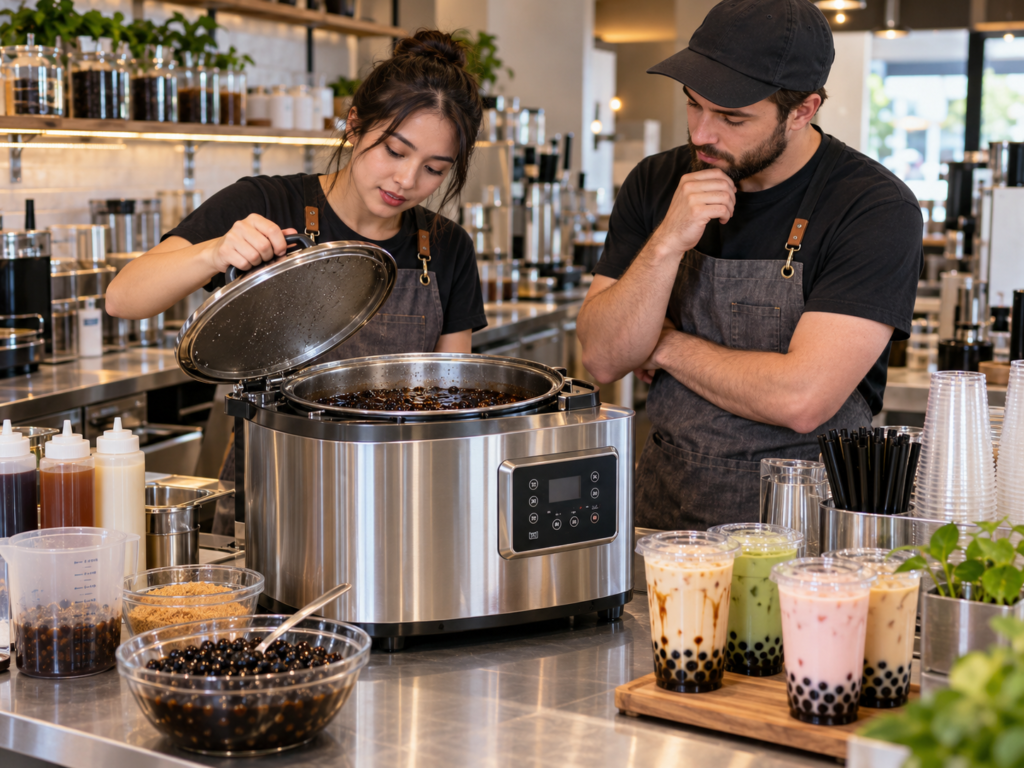
A commercial boba cooker should match your pearl recipe, peak demand and preparation workflow. Choosing by vessel size alone can leave a shop with slow replenishment, unnecessary waste or inconsistent texture. This guide explains seven practical checks for comparing an automatic boba cooker before purchasing equipment for a bubble tea shop, cafe or dessert business.
Quick answer: choose a machine by its tested finished pearl yield and complete batch cycle, then confirm recipe compatibility, controls, electrical requirements, cleaning access and service support. A larger pot does not automatically provide more usable output per hour.
What Does a Commercial Boba Cooker Do?
A commercial boba cooker heats and cooks prepared tapioca pearls using the controls available on the selected machine. Depending on its design, it may provide timed cooking, temperature adjustment, holding or other programmed stages. Confirm each function from the actual operating manual and a demonstration.
A tapioca pearl cooker is different from a pearl forming machine. The cooker prepares suitable ready-made pearls for serving; a pearl maker forms dough into raw pearls. A holding pot mainly maintains prepared toppings. These equipment types solve different tasks, even when listings use similar phrases such as boba machine or bubble tea machine.
| Equipment | Main task | What to verify |
|---|---|---|
| Automatic boba cooker | Cook suitable prepared pearls | Recipe, batch yield, cycle and operator steps |
| Pearl forming machine | Form tapioca dough into raw pearls | Dough specification, forming size and output |
| Topping warmer | Hold prepared toppings under a defined procedure | Temperature control, product quality and handling limits |
1. Calculate Finished Pearl Demand Before Comparing Capacity
Start with drinks sold during the busiest service period. Record the share of orders that include pearls and the cooked pearl weight used per drink. Use finished, drained pearl weight for this calculation so the serving requirement stays consistent.
Finished pearls needed = peak drinks × share requiring pearls × cooked pearl portion.
For an illustrative shop selling 100 drinks in one peak hour, with pearls in 70% of orders and a 50g cooked portion, demand is 100 × 0.70 × 50g = 3,500g, or 3.5kg of finished pearls. These are hypothetical planning figures, not a machine rating or a recommended serving size.
Then allow for the shop’s actual waste, portion variation and replenishment schedule. Avoid adding an arbitrary large buffer: excess production can create more leftover toppings. Measure real sales and adjust the plan after opening or changing the menu.
When requesting a commercial boba cooker quotation, provide this demand calculation. It gives the supplier a clearer target than simply asking for a large-capacity machine or a cooker for a certain number of cups.
2. Separate Vessel Volume, Ingredient Load and Batch Yield
Liters describe volume, while kilograms describe mass. A 12L vessel does not establish how many kilograms of dry pearls it can cook or how much finished product it will deliver. Water requirements, expansion, foaming and the maximum fill line all influence the approved working load.
Ask the supplier to distinguish three figures: nominal vessel capacity, permitted raw pearl load for a specified recipe, and the drained finished yield achieved in a test. A statement such as “2kg capacity” is incomplete unless it identifies whether that weight refers to dry, uncooked or finished pearls.
Also check the smallest practical batch. A shop with uneven demand may need smaller preparations between rushes. The best commercial boba cooker for that workflow must perform acceptably at the intended everyday load, not only during a maximum-capacity demonstration.
3. Measure the Complete Batch Cycle
The time shown on a cooking display may cover only part of production. Heat-up, loading, cooking, resting where required, draining, sweetening and cleaning can all affect how quickly the next batch becomes available.
Theoretical finished output per hour = validated finished batch yield × 60 ÷ complete cycle minutes. Use this only as a starting calculation. Shared preparation space, operator availability and interruptions can reduce practical output.
For example, a hypothetical test yielding 2kg of finished pearls every 40 minutes suggests 3kg per hour before operational losses. That would fall short of the earlier 3.5kg peak-hour example if the shop relies only on production during that hour. A suitable preparation schedule or different equipment arrangement would be needed.
Ask for a full-cycle video with the batch size and ingredient identified. A short clip of boiling water cannot establish pearl yield, finished texture or repeat-cycle performance. Time unloading and reset as carefully as the heating stage.
4. Test Your Actual Tapioca Pearl Recipe
Conventional pearls, quick-cooking products and instant varieties can have different instructions. Start with the directions for the exact ingredient, then confirm whether the equipment can follow the necessary procedure. Do not transfer one supplier’s time setting to every pearl brand.
For example, Bossen publishes separate preparation information for its Fast Cook Big Tapioca. This illustrates why ingredient-specific instructions matter; it does not establish compatibility with a particular machine or replace its manual.
During a commercial boba cooker trial, evaluate the center of the pearl, chewiness, separation and consistency across the batch. Repeat the assessment at the intended point of service. A sample that tastes acceptable immediately after cooking may not match the shop’s later serving conditions.
Record the ingredient brand, batch weight, water quantity, control settings, finishing method and finished yield. Change one variable at a time when refining the recipe. A written record helps staff reproduce the result and lets a distributor compare machines on the same basis.
5. Check Controls and Required Staff Tasks
“Automatic” can describe very different levels of assistance. Some machines automate heating and timing while still requiring manual loading, stirring at specified stages or draining. Others have additional mechanisms. Ask which steps remain with staff and confirm them during the demonstration.
Review display visibility, button labels, adjustment steps and the transition from cooking to holding. Ask what happens when a cycle finishes or power is interrupted. Do not assume that a smart cooker includes automatic water filling, agitation, drainage or recipe memory unless those functions are documented.
Choose controls your team can use consistently under service pressure. A clear, repeatable operating sequence is more useful than an impressive feature list that staff cannot easily apply. Include training and an understandable manual in the purchasing discussion.
6. Confirm Installation, Cleaning and Holding Procedures
Verify the nameplate voltage, frequency, rated power and plug for the exact ordered version. A listing showing 110V/220V often refers to alternative versions. It should not be read as automatic dual-voltage operation. Have the installation checked against the premises and local requirements.
Measure the counter, lid-opening clearance and the space needed to handle hot contents. Plan a suitable draining and finishing area nearby. The commercial boba cooker must fit the working station as well as the countertop footprint shown in a catalog.
Ask which parts can be removed, how the inner surface should be cleaned, and whether replacement vessels or lid components are available. Nonstick surfaces require compatible tools and cleaning products. Follow the manual for disconnection, cooling and protection of electrical components.
A keep-warm setting does not define an unlimited usable life for cooked pearls. Establish holding and discard procedures using ingredient guidance and applicable local food handling requirements. Label batches and assess serving quality separately from the machine’s displayed setting.
7. Compare Service Support and Total Operating Cost
Purchase price is only one part of the decision. Consider staff time per batch, wasted ingredients, cleaning work, replacement parts and downtime. Compare these costs using the same production target and test recipe for every shortlisted machine.
Before ordering, obtain the exact specification sheet, manual, warranty terms and available parts list. Ask how faults are diagnosed and how long replacement components usually take to reach your destination. Distributors should also confirm packing, documentation and the consistency of supplied configurations.
A commercial boba cooker with a well-matched batch size and practical service support may suit a shop better than a larger unit with unclear operating requirements. Base the choice on demonstrated performance and written supply details.
Commercial Boba Cooker Acceptance Checklist
- Identify the pearl brand and the exact recipe used in the trial.
- Record raw pearl weight, water quantity and approved fill limits.
- Measure drained finished yield using a consistent method.
- Time the full cycle, including unloading and preparation for the next batch.
- Check texture immediately and at the intended service point.
- Test the routine batch size as well as the largest proposed load.
- Confirm control functions and every remaining manual task.
- Match electrical specifications, installation space and opening clearance.
- Review cleaning access, spare parts and written support terms.
Plan the Whole Bubble Tea Equipment Station
Pearl cooking is one stage in drink production. A shop can still have queues if syrup dosing or cup sealing is slower than the topping station. Review ingredient preparation, tea brewing, assembly and sealing together before expanding just one machine.
Explore the YLT Motion commercial automatic boba cooker, and compare it with your recipe and demand checklist. For the wider station, review a digital fructose syrup dispenser and a commercial cup sealing machine. Confirm compatibility and configuration for each item rather than assuming a complete line has one fixed output.
YLT Motion supplies commercial beverage and food preparation equipment for distributors, restaurants, cafes and hospitality businesses. Share your pearl recipe, destination, electrical supply and peak serving requirement when requesting an equipment recommendation.
Frequently Asked Questions
What size commercial boba cooker does a small shop need?
Calculate peak cooked pearl demand, then compare it with tested batch yield and the full replenishment cycle. Shop size and vessel liters alone do not establish the correct equipment capacity.
Can one automatic boba cooker handle every type of pearl?
Compatibility depends on the ingredient instructions and the machine’s controls and operating method. Test the exact pearls you intend to serve before adopting a standard recipe.
Does a pearl cooker also form raw boba?
A cooker heats suitable prepared pearls. A pearl forming machine processes dough into raw pearls. Confirm the task before comparing machines with similar names.
Should a shop always buy the largest cooker?
Compare useful batch sizes, staff tasks and the sales pattern. Oversized batches can increase leftovers, while insufficient replenishment can interrupt service. Match the equipment to measured demand.
What information should buyers send to a supplier?
Provide the pearl brand, expected cooked portion, peak drinks requiring pearls, preparation schedule, electrical supply, destination and order quantity. Request a written specification and a representative batch test.