العربية — تفاصيل المنتج أو الدليل
Bahasa Indonesia — Lihat produk atau panduan ini
Tiếng Việt — Xem nội dung bằng tiếng Việt
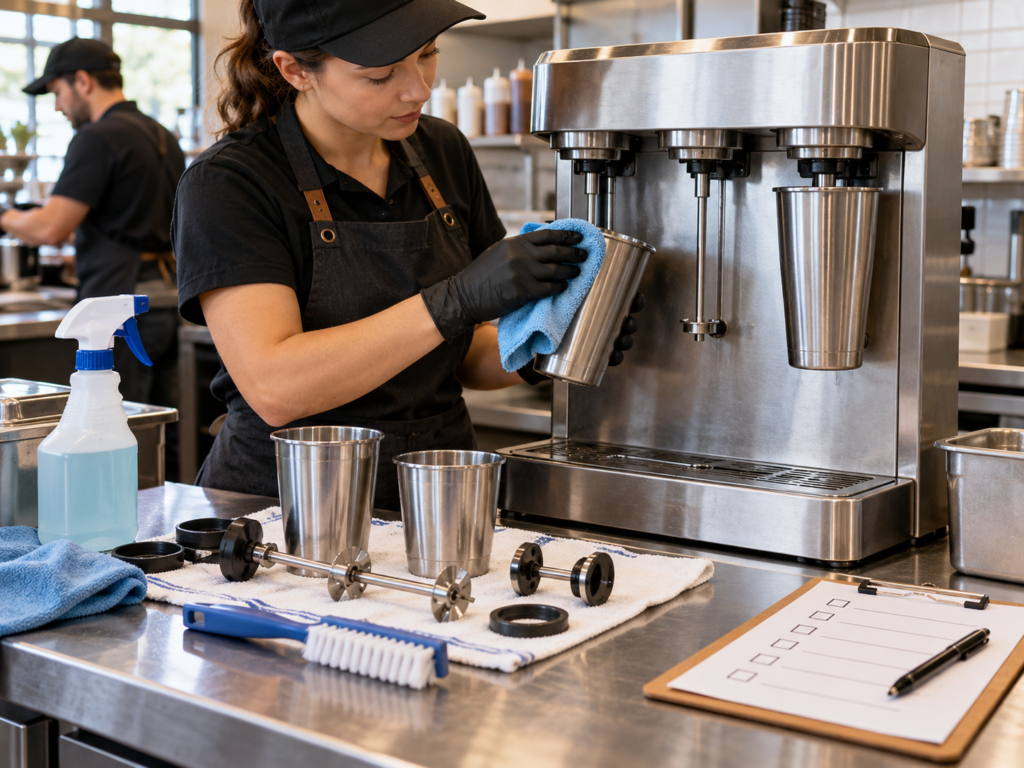
Commercial milkshake machine cleaning starts with the correct model manual, a clear work sequence and a record of who completed each task. For cafes, dessert shops and restaurants, visible milk residue, an unclean cup support or a loose agitator can disrupt service. This guide explains a practical cleaning and maintenance routine for spindle drink mixers, including single-head and double-cup formats.
Quick answer: Remove drink residue, wash permitted food-contact parts, rinse, apply the approved sanitizing procedure and allow parts to drain or air-dry as directed. Keep the motor housing dry. Disconnect power before manual cleaning, disassembly or servicing. Run a powered cleaning cycle only when the exact machine manual explicitly instructs it.
Commercial Milkshake Machine Cleaning: 7 Practical Checks
- Identify the model and approved cleaning procedure.
- Separate washing from sanitizing.
- Inspect cups, spindles, agitators and cup supports.
- Control milk residues and allergen cross-contact.
- Keep water away from electrical components.
- Record wear, unusual vibration and overheating.
- Verify cleanliness before returning to service.
1. Read the Drink Mixer Manual Before Cleaning
Commercial drink mixers differ in their removable components, cup activation switches and cleaning cycles. One model may allow an agitator to be removed by hand, while another requires a specific tool or service procedure. Never copy a disassembly method from a similar-looking machine without confirming compatibility.
Keep the operating manual near the workstation. Record the approved detergent, sanitizer, cleaning tools and removable parts. Confirm which items may be immersed and whether dishwasher use is permitted. Stainless steel construction does not establish that the whole appliance is waterproof.
2. Understand Cleaning Versus Sanitizing
Cleaning removes food residue and soil. Sanitizing is a separate process applied to already cleaned food-contact surfaces using the approved method. A quick rinse may remove some milk but does not replace a complete cleaning and sanitizing procedure.
Use products suitable for the equipment and follow their label instructions for dilution, temperature, contact time, rinsing and drying. Verify concentration with the appropriate test method where required. Do not mix chemicals, improvise a stronger solution or transfer a sanitizer recipe between different products.
3. Clean the Cup, Spindle and Mixing Attachment
After stopping the machine, wait until the mixing attachment has stopped moving. Disconnect power before handling or removing parts for manual cleaning. Remove the cup and any other components that the manual identifies as user-removable. Do not reach around a moving spindle.
Discard leftover drink and remove accessible residue with the approved tools. Wash and rinse permitted removable components, then sanitize them according to the documented procedure. Inspect cup rims, the underside of mixing discs and other accessible joints where residue may remain. Avoid abrasive tools that damage food-contact surfaces.
Some manufacturers specify a powered wash or sanitizing cycle with solution in the cup. That is a model-specific procedure, not a general instruction to operate every mixer while cleaning. Follow the manual’s sequence for reconnecting power and keeping hands clear, then disconnect again before subsequent manual handling.
4. Wipe the Housing and Cup Support
Clean the exterior with the manufacturer-approved cloth and cleaning product. Keep liquid away from vents, switches, electrical connections and the motor assembly. Do not spray or submerge the mixer. The Hamilton Beach drink mixer manual linked below explicitly distinguishes cleaning the container and spindle from caring for the housing.
Inspect the cup support and activation area for splashes. Clean these areas only as instructed, without defeating an interlock or forcing a switch. Reassemble approved parts after they have drained or dried as required and check that the cup sits securely.
5. Plan for Milk Residues and Allergens
A milkshake mixer may contact dairy, nut ingredients, soy, powders and flavoured additions during one service period. Build cleaning into the recipe changeover process rather than relying on a brief water rinse. Follow the business’s food safety and allergen management procedures.
A dedicated cup alone does not prevent cross-contact when the same spindle and mixing attachment touch multiple recipes. Where an allergen-controlled order is requested, assess the complete preparation route, including utensils and storage. Do not promise an allergen-free drink unless the business can substantiate that claim.
6. Inspect Wear Before It Becomes Downtime
Daily checks should cover visible cup damage, loose or damaged mixing components, an unstable base and cable defects. If the spindle vibrates unusually or the mixing attachment appears bent, stop using the machine and arrange assessment. Do not adjust moving parts while the machine is connected.
Overheating, a burning smell, repeated protective shutdowns or unusual mechanical noise require investigation. Excessively thick recipes, overfilling and insufficient cooling time may contribute to operating problems, but staff should not assume a cause without checking the manual and obtaining qualified service when needed.
7. Record the Commercial Milkshake Machine Cleaning Routine
A short cleaning log makes handover easier. Record the date, machine identification, completed cleaning steps, sanitizer verification where required, inspection findings and staff initials. Record any fault and the action taken before reopening the station.
| Checkpoint | What to record or verify |
|---|---|
| Before service | Clean components, secure assembly, intact cable and stable placement |
| During service | Spills, recipe changeovers and cleaning triggers defined in the food safety procedure |
| Closing routine | Complete wash, rinse, sanitize and drying sequence for approved parts |
| Maintenance review | Wear, spare parts requirements and service findings according to the manual |
Set cleaning frequency using the equipment manual and the site’s food safety procedure. A closing clean does not replace cleaning required during service. Double-cup milkshake machines need checks of both positions; do not assume an unused-looking attachment is clean.
Common Commercial Drink Mixer Problems
Why does the machine vibrate?
Stop operation and check the approved cup placement and visible attachment condition with power disconnected. An uneven load, a damaged component or an installation issue may require attention. If the cause is unclear, keep the equipment out of service until assessed.
Why are drinks inconsistent?
Compare ingredient weights, ingredient temperature, cup loading, approved speed and mixing time. Cleanliness and attachment condition also matter. Do not compensate for worn components by running beyond the specified duty cycle.
Can I wash the whole milkshake maker in a sink?
No. Keep the powered housing out of water. Only immerse components explicitly approved by the manufacturer. Follow the exact instructions for cleaning around fixed spindles and switches.
Can I use the same procedure for every milkshake machine?
No. Treat this article as a planning guide and use the exact model manual for disassembly, cleaning cycles, chemicals and reassembly. Where instructions are unclear, ask the supplier before proceeding.
Choose Equipment With Cleaning Access and Spare Parts Support
Before buying a commercial milkshake machine, ask how cups and mixing attachments are cleaned, which parts are replaceable and whether an operating manual is supplied. Evaluate the complete preparation and cleaning workflow during a sample trial. A machine that fits the menu should also fit the cleaning time available to staff.
Explore YLT Motion commercial beverage and food preparation equipment for cafe, restaurant and distributor sourcing. Provide the model reference when asking about compatible parts, documentation and maintenance support.
Reference and Scope
For an example of manufacturer-specific instructions, see the Hamilton Beach drink mixer use and care manual. It is a reference for the equipment described in that document, not an instruction manual for YLT Motion products. Always use the documentation supplied for your actual machine.